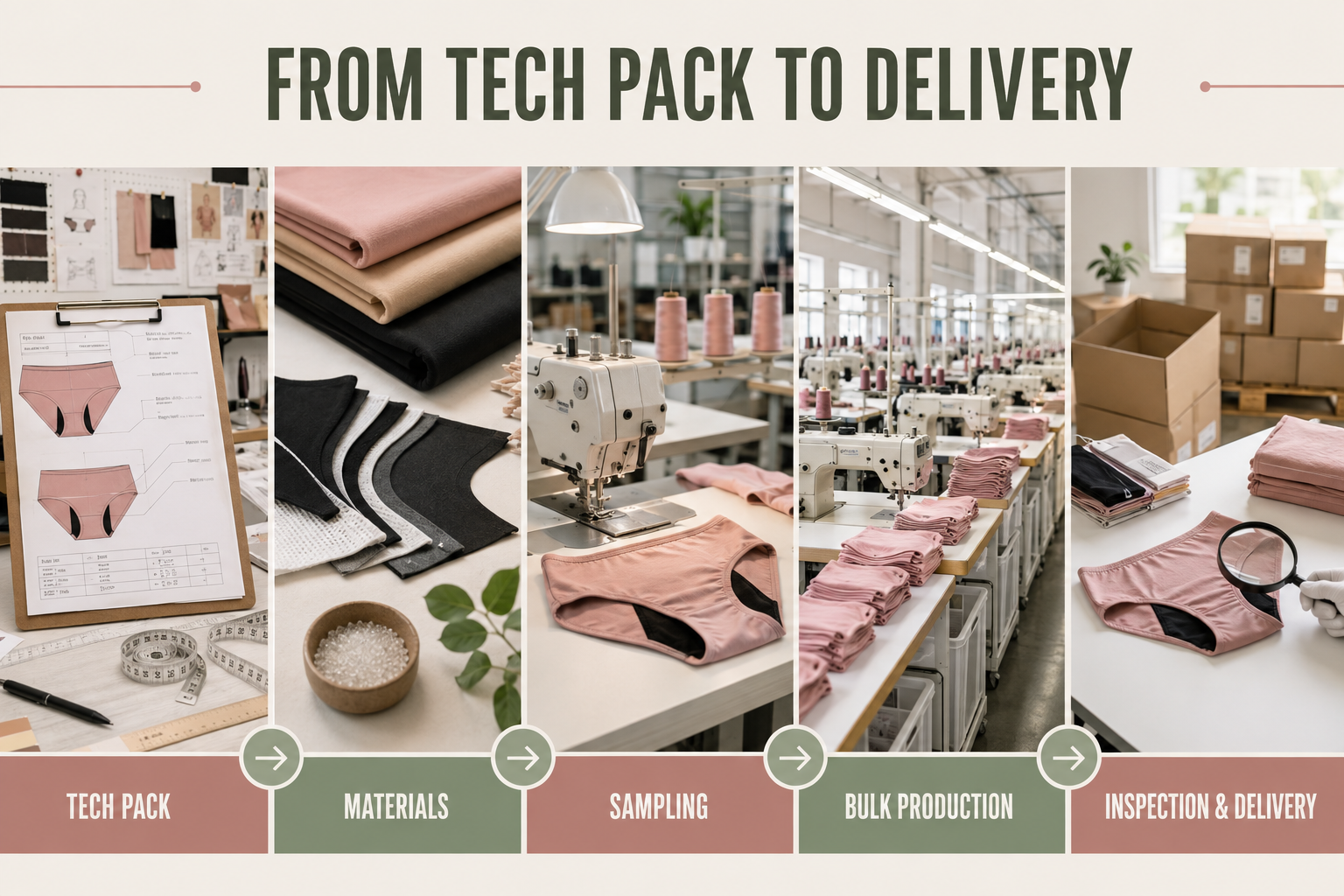
The period underwear manufacturing process is more complex than producing ordinary briefs. A factory must coordinate body fabric, absorbent layers, a leak-resistant barrier, elastics, seams, fit, washing performance, labeling, and packaging as one controlled product system.
For private label buyers, the safest route is not “send a design and wait for bulk goods.” It is a sequence of approval gates: define the product, confirm measurable specifications, develop samples, test the final construction, seal a pre-production standard, and inspect bulk production against that standard. This guide explains each stage and the decisions a buyer should complete before moving forward.
Process summary: a controlled program moves from buyer brief and tech pack to material confirmation, pattern and gusset engineering, sample approval, absorbency and wash testing, pre-production sealing, bulk sewing, final inspection and packaging. Each stage should have a clear approval record before the next stage begins.
Why Period Underwear Manufacturing Needs More Control
Ordinary underwear development already requires accurate patterns, stretch control, seam quality, color consistency, and size grading. Period underwear adds a functional gusset whose layers must acquire, distribute, store, and resist liquid without creating excessive bulk or discomfort.
A visually correct sample can still dry too slowly, rewet under pressure, shrink after washing, delaminate, or leak at the edge of the gusset. A sample with good absorbency can still fail because the waistband rolls, the leg opening gaps, or the graded sizes do not fit consistently. This is why appearance, fit, function, durability, and compliance must be approved separately before they are treated as one finished standard.
The Period Underwear Manufacturing Process in 10 Stages
| Stage | Main activity | Buyer approval |
|---|---|---|
| 1. Product brief | Define customer, silhouette, absorbency, price position, size range, colors, quantity, and launch date | Approved development direction |
| 2. Tech pack and BOM | Translate the concept into measurements, materials, construction, artwork, testing, and packaging specifications | Controlled working document |
| 3. Material confirmation | Source and review body fabrics, gusset layers, elastics, thread, labels, and trims | Approved swatches and documents |
| 4. Pattern and gusset engineering | Develop the base pattern, gusset geometry, layer placement, seams, and grading logic | Pattern direction approved for sampling |
| 5. Prototype sampling | Cut and sew the first complete garment | Initial construction review |
| 6. Fit and function revisions | Correct measurements, fit, layer performance, thickness, drying, and workmanship | Revision comments closed |
| 7. Pre-production approval | Confirm the final sample, size set where required, colors, artwork, packaging, and test status | Sealed production standard |
| 8. Bulk cutting and sewing | Inspect incoming materials, cut controlled bundles, assemble garments, and manage line quality | Production follows approved standard |
| 9. Inspection and testing | Complete inline checks, final random inspection, measurements, appearance checks, and agreed performance verification | Shipment release decision |
| 10. Packing and delivery | Apply labels, pack units, verify cartons and shipping marks, and prepare shipment documents | Shipment handover |
These stages can overlap, but the approval logic should not disappear. If a factory starts bulk material or cutting before the buyer has closed key sample decisions, the project may save a few days at the beginning and lose weeks through rework later.
Stage 1: Build a Buyer Brief Before Requesting Samples
A sample request should describe a product and a market, not only a reference photo. Start with the target customer, use scenario, style, rise, coverage, absorbency level, preferred hand feel, target retail position, size range, colors, branding, packaging, destination market, order quantity, target cost, and required delivery date.
If you have not selected a supplier, first review our guide on how to choose a period underwear manufacturer. A development partner should be able to explain tradeoffs between fit, absorbency, thickness, drying time, material availability, MOQ, testing, and cost instead of simply agreeing to every request.
Stage 2: Convert the Idea into a Tech Pack and BOM
The tech pack becomes the working contract between the buyer, pattern team, sample room, material suppliers, production line, and quality team. It should be version-controlled so everyone knows which revision is current.
- Front, back, side, and gusset drawings
- Point-of-measure chart with measurement method and tolerances
- Base size, size range, and grading rules
- Bill of materials for every body and gusset component
- Fabric composition, construction, GSM, stretch, recovery, and finish
- Gusset layer sequence, dimensions, placement, and seam method
- Elastic, thread, label, logo, and trim specifications
- Color standards and shade approval method
- Absorbency, leakage, wash, and other test requirements
- Care label, packaging artwork, barcode, carton, and shipping-mark details
Do not use words such as “soft,” “high absorbency,” or “good stretch” as the only specification. Our period underwear materials guide explains the measurable fields buyers should confirm for the body fabric, skin-contact layer, absorbent core, barrier, elastics, and seams.
Stage 3: Confirm Materials Before Finalizing the Sample
Material approval is more than choosing a color card. Request actual swatches, specifications, minimums, lead times, certificate scope where applicable, and availability for repeat orders. Confirm whether the development sample uses production-intended materials or substitutes.
A substitute may be acceptable for an early fit sample, but it cannot prove final stretch, recovery, shrinkage, hand feel, drying time, lamination durability, or absorbency. The pre-production sample should use the intended bulk construction unless the buyer has documented and accepted a remaining difference.
Stage 4: Engineer the Pattern and Functional Gusset
Pattern development connects the body and functional layers. The team must control rise, coverage, leg opening, waistband tension, gusset width and length, front and back extension, seam positions, layer stretch, and thickness. The functional area must stay in the intended position during movement and across the size range.
Increasing absorbent material alone does not guarantee a better product. Capacity, acquisition speed, distribution, rewet, barrier performance, gusset area, compression, fit, and drying time work together. Use the period underwear absorbency levels guide to convert light, moderate, heavy, or overnight positioning into a measurable development target.
Stages 5–7: Understand the Main Sample Types
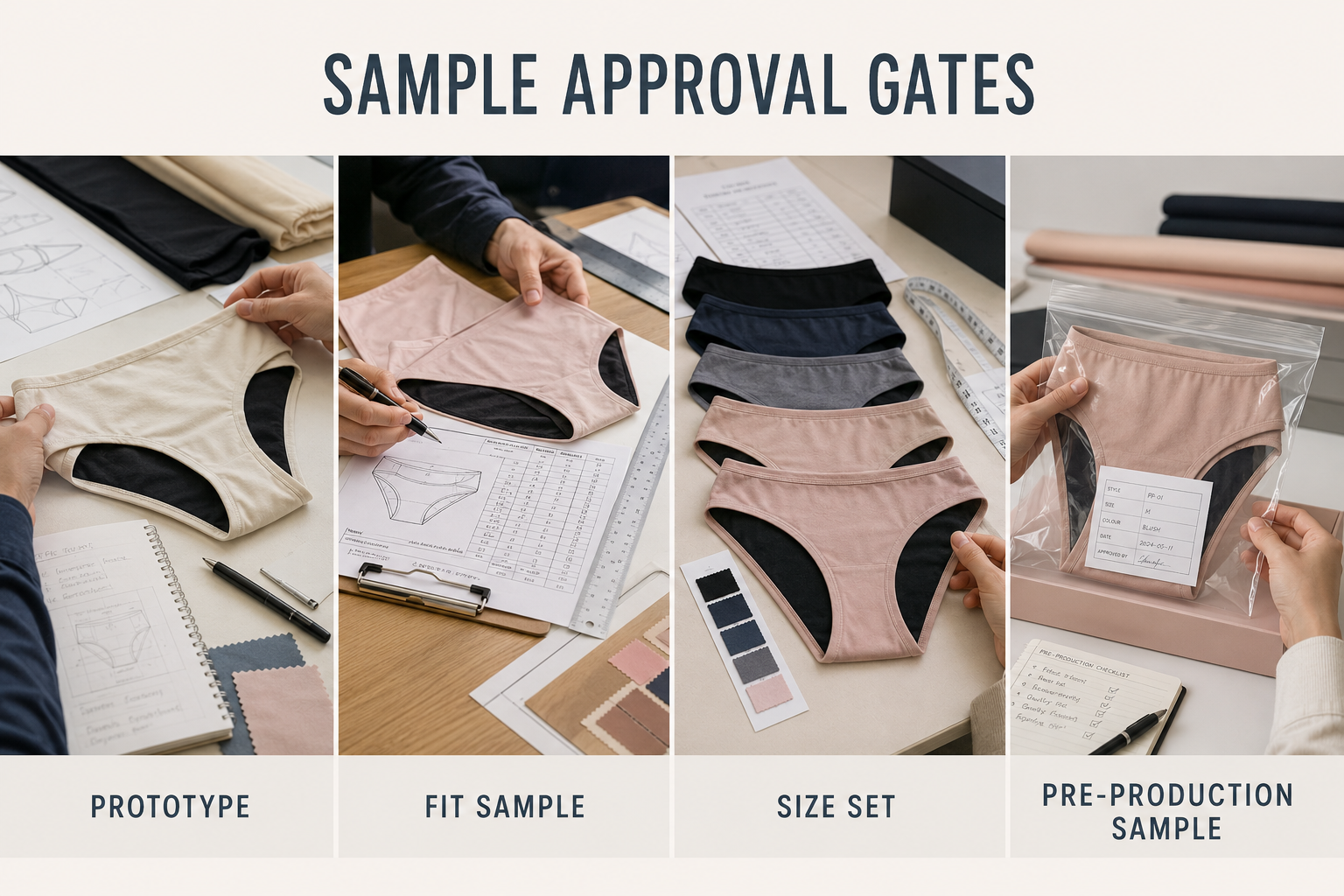
| Sample type | Purpose | What the buyer should check |
|---|---|---|
| Reference or selection sample | Choose an existing base style or communicate a benchmark | Which features are references and which must be changed |
| Development prototype | Prove the first complete construction | Silhouette, material direction, gusset concept, workmanship, and obvious risks |
| Fit sample | Correct measurements, balance, coverage, and tension | Fit on the agreed body or form, measurement chart, recovery, and movement |
| Function sample | Evaluate liquid management and wash performance | Intake, spreading, capacity, rewet, leakage, drying, and durability under the agreed method |
| Size-set sample | Check grading across representative sizes | Proportion, gusset placement, elastic tension, and measurement consistency |
| Pre-production sample | Seal the final standard before bulk | All materials, colors, construction, labels, artwork, packaging, fit, and required test status |
One physical garment may serve more than one purpose, but the approval record should state what was actually reviewed. For example, a fit sample made with substitute fabric should not be marked as final material approval.
How to Review and Comment on Samples
Send one consolidated comment sheet per revision. Use photos with arrows, point-of-measure references, expected values, actual values, and a clear action for each issue. Separate comments into approved, revise, confirm, and information-only items.
- Record the sample version, date, color, size, and material status.
- Measure the garment using the same method stated in the tech pack.
- Review fit on the agreed body, fit model, or form.
- Wash and retest the construction under the agreed care protocol.
- Do not combine comments from different reviewers without resolving conflicts.
- Close each comment in the next revision instead of starting a new untracked list.
- Keep one signed or sealed final sample as the bulk reference.
Performance Tests Before Bulk Production
The testing plan should match the product claim and destination market. Bureau Veritas describes testing for period and leakproof underwear and notes that moisture-management testing can support performance areas such as quick dry and breathability. Buyers should agree on the sample condition, liquid or test medium, application method, pass/fail limits, wash cycles, laboratory, and reporting format before testing begins.
| Test area | Possible checks | Why it matters |
|---|---|---|
| Liquid management | Acquisition speed, distribution, total capacity, retention under pressure, rewet, and leakage | Supports the intended absorbency and wear scenario |
| Wash durability | Performance after agreed wash cycles, lamination bond, seam condition, elastics, and appearance | Confirms that the product remains functional after use and care |
| Fit and recovery | Measurements, stretch, recovery, waistband and leg tension, and gusset stability | Reduces gaping, rolling, movement, and inconsistent sizing |
| Fabric performance | Shrinkage, pilling, colorfastness, staining, drying, and opacity | Protects appearance, care claims, and size consistency |
| Construction | Seam strength, seam slippage, bonding or lamination integrity, and workmanship | Reduces failure at layer edges and stress points |
| Safety and claims | Fiber content, restricted substances, PFAS scope where required, and claim documentation | Connects the final bill of materials to market and brand requirements |
A factory demonstration can be useful during development, but it is not automatically a substitute for a defined third-party laboratory program. Decide which checks are internal development tests and which reports are required for compliance, retailer approval, or marketing claims.
Stage 7: Seal the Pre-Production Standard
Bulk production should start from a controlled approval package, not scattered chat messages. The final package normally includes the approved pre-production sample, current tech pack, BOM, measurement chart, color and material standards, artwork, packaging files, test requirements, defect criteria, and purchase order.
List any permitted tolerances or approved differences. If a bulk material, trim, adhesive, membrane, or construction method changes after approval, require a documented review before the substitution enters production.
Stage 8: Bulk Cutting, Sewing, and Line Control
Before cutting, incoming materials should be checked against approved composition documents, width, weight, shade, stretch, shrinkage, surface quality, and lamination condition as applicable. Cutting control should protect shade consistency, size identification, layer orientation, gusset placement, and bundle traceability.
During sewing or bonding, the quality team should watch seam allowance, stitch consistency, skipped stitches, needle damage, puckering, elastic tension, gusset alignment, barrier punctures, bonding temperature or pressure where used, labels, and measurements. Finding a repeat defect during inline inspection is less expensive than discovering it after the entire order is packed.
Stage 9: Final Inspection and Shipment Release
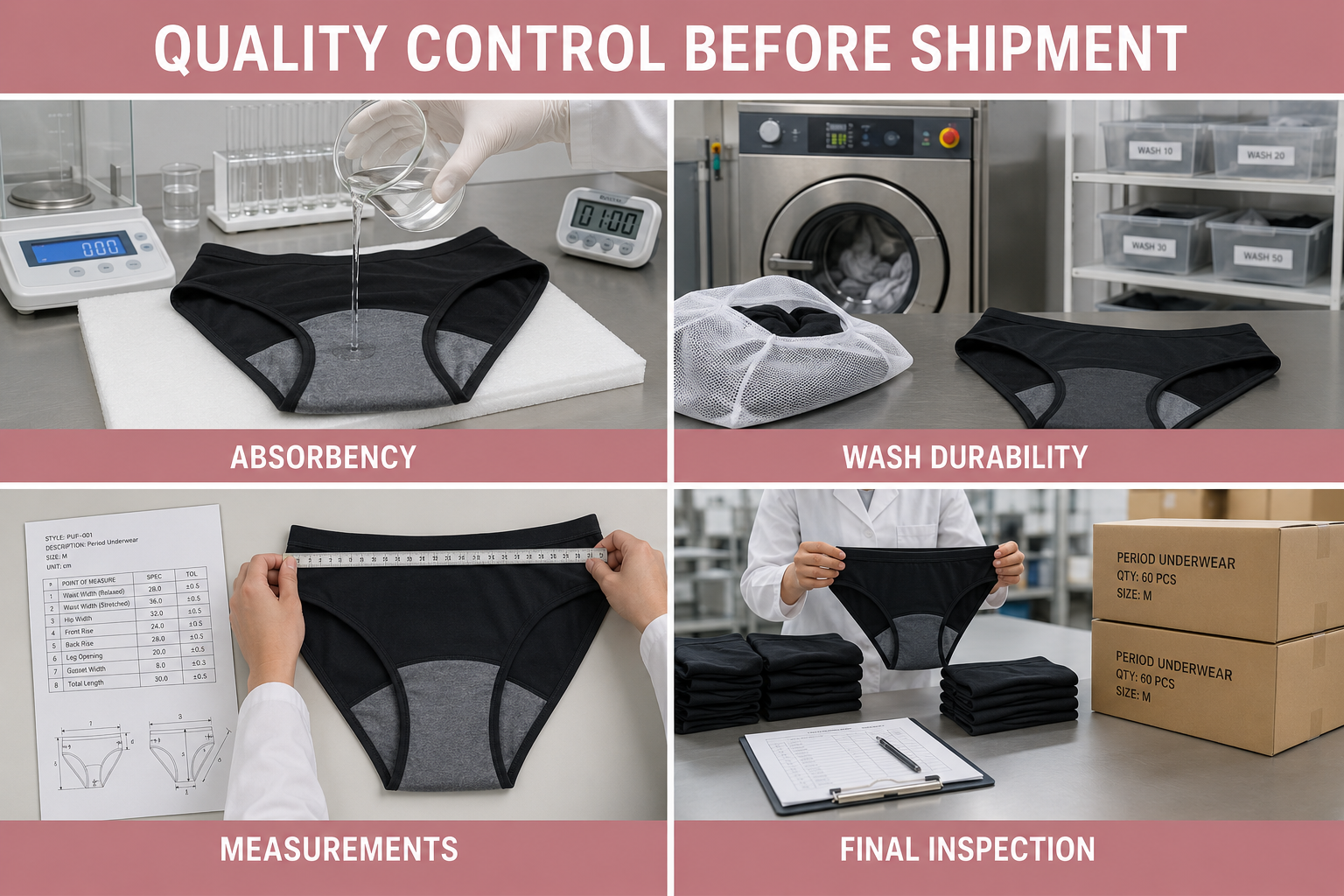
A final inspection plan should define the lot, sampling method, defect classification, acceptance criteria, measurements, functional spot checks, packaging checks, and reporting format. ISO 2859-1:2026 defines acceptance sampling plans for inspection by attributes. The buyer and inspector should agree which sampling plan and quality limits apply instead of using the word “AQL” without a written inspection specification.
Final inspection commonly covers quantity, style and color assortment, appearance, workmanship, measurements, labeling, barcode, packaging, carton condition, and shipping marks. SGS describes final selective textile inspections that include quality, quantity, packaging, marking, and shipment marking. Functional laboratory testing and final visual inspection serve different purposes; one should not be assumed to replace the other.
A Practical First-Order Timeline
The following ranges are planning examples, not a quotation. Actual timing depends on product complexity, material availability, number of revisions, test scope, order quantity, factory capacity, packaging, and transport.
| Activity | Indicative planning range | Main dependency |
|---|---|---|
| Brief and tech review | 2–5 working days | Complete requirements and fast clarification |
| Material sourcing and confirmation | 5–15 working days | Stock availability, custom color, certification, and swatches |
| First prototype | 7–14 working days | Pattern complexity and sample-room capacity |
| Each revision round | 5–10 working days | Clear consolidated comments and material changes |
| Pre-production or size-set approval | 5–10 working days | Final materials, artwork, packaging, and tests |
| Bulk production | 20–40 working days | Quantity, material booking, line capacity, and construction |
| Final inspection and packing release | 2–5 working days | Inspection result, rework, documents, and booking |
Plan backward from the required warehouse date, not the marketing launch date. Include sample shipping, laboratory turnaround, artwork approval, production, inspection, freight booking, customs, and receiving time. A small initial garment order can still be delayed by a custom fabric or packaging minimum; see our private label period underwear MOQ guide for the difference between garment, material, color, and packaging minimums.
Seven Causes of Avoidable Production Delay
- An incomplete brief: The factory must repeatedly request sizes, materials, absorbency, artwork, or packaging details.
- Uncontrolled revisions: Different comments are sent through email, chat, and marked samples without one current version.
- Late material changes: A new body fabric or gusset layer forces new fit, shrinkage, wash, and performance checks.
- Undefined test criteria: The buyer and supplier disagree about what “heavy absorbency” or “leakproof” means after sampling.
- Packaging starts too late: Barcodes, claims, translations, warnings, and carton marks are not approved before production is ready.
- No size-set review: Grading problems appear only after multiple sizes enter bulk production.
- Booking production before approval: Materials or line time are committed while key sample decisions remain open.
Choose the Right Development Route
Existing style with private label branding
Best for a faster market test when the existing fit, materials, absorbency direction, and available colors suit the brand. Changes may focus on logo, care label, packaging, and selected colors.
Semi-custom development
Best when a proven base can be adjusted through fabric, color, gusset capacity, waistband, trims, or packaging. Buyers should confirm which changes affect MOQ, testing, and sample rounds.
Full custom OEM development
Best for a proprietary silhouette, construction, size system, material specification, or performance target. It requires the most complete tech pack, material work, pattern development, testing, approval control, time, and budget.
Manufacture Private Label Period Underwear with Linglu
Linglu supports buyers through style selection, material and gusset development, sampling, branding, packaging, and bulk production planning. The right starting route depends on how much of the product is already defined and how quickly the brand needs to validate the market.
Explore our period underwear styles, then contact Linglu with your target customer, style, absorbency, materials, size range, quantity, branding, packaging, destination market, and launch date. We can help organize the information into a practical sampling brief.
Frequently Asked Questions
How long does the period underwear manufacturing process take?
A first custom order often requires material confirmation, one or more sample rounds, testing, pre-production approval, bulk production, inspection, and shipping. The exact schedule depends on complexity, revisions, materials, quantity, packaging, laboratory scope, and factory capacity. Ask for a stage-by-stage calendar based on the approved specification rather than a single production number.
What should a buyer send to start sampling?
Send the target customer, style or reference, absorbency level, material direction, size range, colors, quantity, branding, packaging, target cost, destination market, required tests, and launch date. A tech pack is preferred, but an experienced manufacturer can help turn a structured brief into a development specification.
How many samples are needed before bulk production?
There is no fixed number. A simple private label route may need fewer rounds, while a new fit, custom gusset, special material, or broad size range may need several. The correct number is the number required to close fit, function, material, artwork, packaging, and test approvals without leaving uncontrolled risks.
Why is a pre-production sample important?
It connects the final material, construction, measurements, color, labels, artwork, packaging, and approval status in one physical reference. Bulk production and inspection can then compare against a sealed standard instead of relying on separate messages or an early prototype.
Should absorbency be tested again after washing?
Yes, when repeat-use performance is part of the product requirement. The buyer should define the wash protocol, number of cycles, drying method, and performance retest points. Washing can change fabric finish, shrinkage, layer behavior, elastics, seams, lamination, intake, drying, and leakage performance.
Can a new brand start with a low MOQ?
It depends on the development route. Existing styles and stock materials may support a smaller test order, while custom colors, fabrics, laminations, elastics, and packaging can each create separate minimums. Ask the supplier to separate garment MOQ from material, color, trim, and packaging MOQ before approving the first order.
Plan the Steps Before Requesting a Quote
- Period Underwear Manufacturer Checklist – Evaluate experience, sampling, testing, quality control and communication.
- Period Underwear Materials – Specify body fabrics, absorbent layers, leak-resistant barriers and durability requirements.
- Period Underwear Absorbency Levels – Turn light, moderate, heavy and overnight claims into measurable test requirements.
- Wholesale Period Underwear – Compare available styles and request matched samples before full customization.
Evaluating a production partner? Review Linglu’s private label period underwear manufacturing capabilities, including typical 100–300 piece programs, sampling, customization, quality checks and lead-time guidance.
Ready to Move from Product Idea to Sample?
Send your tech pack, reference style or target product requirements. We will review the suitable development route, sample timing and starting quantity with you.