Private label period underwear MOQ is rarely one simple number. A supplier may quote 10 pieces, 100 pieces or 1,000 pieces, but the real inventory commitment depends on how that quantity is divided among styles, colors, sizes, fabrics, absorbency levels, logos and packaging.
For a new brand, wholesaler or ecommerce seller, choosing the right minimum order quantity is not just about obtaining the lowest unit price. It is about testing demand without creating too much slow-moving inventory, while still ordering enough stock to evaluate product quality and customer response.
This guide explains how period underwear MOQs work, which details can create separate minimums and how to plan a lower-risk first private label order.
1. What Does MOQ Mean for Period Underwear?
MOQ means minimum order quantity: the smallest quantity a supplier will accept for a particular production route. The phrase sounds straightforward, but a quotation may contain several different minimums at the same time.
| MOQ type | What it controls | Question to ask |
|---|---|---|
| Total order MOQ | The minimum number of pieces across the complete purchase order | Can different styles be combined? |
| Style MOQ | The minimum for each brief, bikini, high-waist or other design | Is the quantity calculated per style? |
| Color MOQ | The minimum for each body-fabric color | Can stock colors be mixed? |
| Size minimum | The quantity required for each size or size run | Can I choose my own size ratio? |
| Logo MOQ | The minimum for heat transfer, printing, woven labels or custom waistbands | Which branding method works at my quantity? |
| Packaging MOQ | The minimum for boxes, bags, sleeves, inserts or printed cards | Does packaging have a separate minimum? |
If a manufacturer says the MOQ is 100 pieces, do not assume that you can divide those pieces in any way. Ask whether the figure applies to the whole order, each style, each color or each size.
2. Compare the Four Main Sourcing Routes
The amount of customization is one of the biggest factors affecting MOQ. A low-quantity test order and a fully custom development project use different materials, processes and setup work.
| Sourcing route | Typical scope | MOQ tendency | Best use |
|---|---|---|---|
| Selected existing style | Existing fabric, absorbency structure, colors and pattern | Lowest | Samples and early market tests |
| Simple private label | Existing product with an approved logo, label or standard packaging option | Low to moderate | First branded launch |
| Modified existing style | Changes to color, fabric, gusset, absorbency or size specifications | Moderate to high | Growing brands with product data |
| Full custom OEM or ODM | New pattern, custom materials, exclusive construction and retail packaging | Highest | Established programs requiring differentiation |
The lowest-MOQ route normally uses more existing components. The more variables a buyer changes, the more likely the factory must purchase dedicated materials, create samples, adjust patterns or set up a separate production run.
3. Why Period Underwear MOQ Varies More Than Standard Underwear
Period underwear combines a body garment with a functional protective gusset. Depending on the design, production may involve a moisture-wicking layer, absorbent material, a leak-resistant barrier and the outer body fabric. The factory must keep the layers aligned while controlling fit, bulk, stretch, stitching and coverage.
MOQ can increase when a project requires:
- A custom-dyed body fabric or exclusive print
- A new waistband color or branded elastic
- A different gusset length or position
- A new absorbency level or layer combination
- Custom pattern development and size grading
- A special logo application method
- Retail packaging printed specifically for the brand
- Testing or documentation for a selected material and market
These are not necessarily problems. They simply mean the buyer should choose a sourcing route that matches the current stage of the business.
4. How Linglu’s Low-MOQ Test Route Works
For selected existing period underwear styles, Linglu Apparel supports test orders starting from 10 pieces. This route is designed for buyers who want to inspect products, create initial content, test a small sales channel or compare several options before committing to a larger order.
A 10-piece starting point does not mean every fully customized design can be manufactured at that quantity. The lowest-quantity route normally depends on available styles, fabrics, colors, sizes and a controlled level of branding. Product availability and the permitted size or color mix should be confirmed before ordering.
This approach can be useful for:
- Startup brands validating their first product direction
- Small wholesalers testing demand from existing customers
- Online sellers preparing photography and product listings
- Buyers comparing fit, absorbency and fabric across selected styles
- Retailers introducing period underwear without overloading inventory
Explore Linglu’s bulk period underwear styles to identify suitable existing styles for a lower-risk test order.
5. Calculate the Real Size of Your First Order
Before comparing quotations, calculate how quickly a simple product plan multiplies. A useful planning formula is:
Total pieces = number of styles × colors per style × sizes per color × units per size
| Illustrative plan | Styles | Colors | Sizes | Units per size | Total |
|---|---|---|---|---|---|
| Focused test | 1 | 1 | 5 | 2 | 10 pieces |
| Broader test | 2 | 2 | 5 | 5 | 100 pieces |
| Multi-style launch | 3 | 3 | 6 | 10 | 540 pieces |
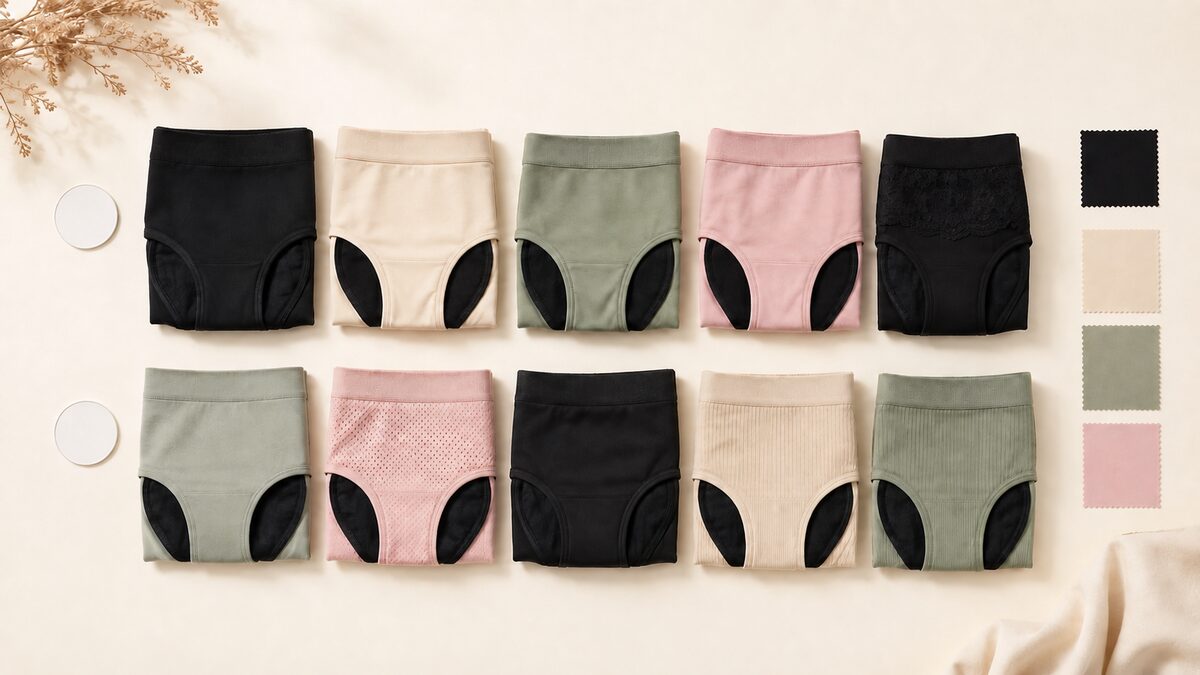
These examples are planning illustrations rather than factory terms. The actual combination depends on product availability and the supplier’s size and color rules. The important point is that adding one more style or color can increase the first order much faster than expected.
6. Watch for Hidden Minimums Outside the Garment
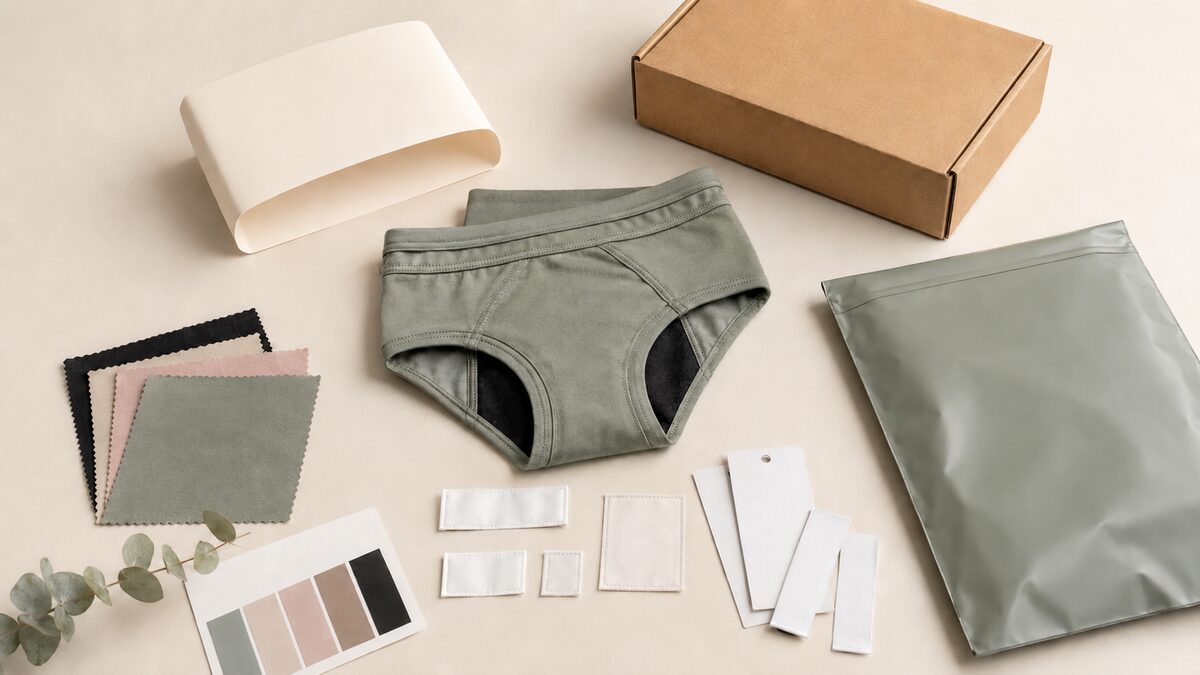
The garment MOQ is only one part of a private label project. Labels, logo applications and packaging may be produced by separate specialist suppliers, each with its own setup cost and minimum.
| Component | Why a separate minimum may apply | Lower-risk first-order approach |
|---|---|---|
| Custom fabric color | Dyeing requires a minimum batch | Start with available colors |
| Custom waistband | Elastic weaving and color matching require setup | Use the existing waistband where suitable |
| Woven label | Label production has its own manufacturing run | Compare with a simpler approved logo method |
| Printed retail box | Printing and die-cutting often require a larger run | Ask about standard packaging or a simpler branded element |
| Instruction card | Paper printing is ordered separately | Use one universal design across the first collection |
Always request a line-by-line quotation. If unused packaging must be produced and stored, confirm who owns it, where it will be stored and whether it can be used for reorders.
7. Do Not Compare MOQ Without Comparing Total Cost
A very low MOQ can reduce inventory exposure, but it may carry a higher unit cost. A larger order may lower the product price while increasing cash tied up in unsold colors and sizes. Neither option is automatically better.
Compare the total landed commitment, including:
- Product unit price
- Sample and development charges
- Logo or printing setup costs
- Labels and packaging
- Inspection or testing costs where required
- Freight, insurance, duties and local delivery
- Payment terms and currency exposure
- Expected defect allowance and sellable units
- Reorder lead time and possible stockout cost
A practical comparison is total landed cost divided by the number of accepted sellable units. This prevents an apparently cheap quotation from looking better only because packaging, setup or freight has been excluded.
8. Build a Lower-Risk First Order
The purpose of a first order is to learn. A focused assortment usually produces clearer information than a large collection with too many variables.
- Choose one customer segment. Decide whether the product is for adults, teens, postpartum users, plus-size customers or another defined group.
- Select one or two hero styles. Avoid launching every waistband and silhouette at once.
- Use one clear absorbency position. Make the use case easy to explain and test.
- Start with controlled colors. Existing neutral or proven colors normally simplify the first order.
- Plan the size curve. Use customer data where available instead of dividing every size equally.
- Keep branding simple. Prioritize a clean logo and compliant product information before complex packaging.
- Set a reorder trigger. Decide in advance when sales or stock levels should start the next purchase order.
After the first test, use sales by size, returns, customer feedback, repeat purchase and product reviews to decide which variables deserve further customization.
9. Information to Send for an Accurate MOQ Quote
A manufacturer cannot give a reliable private label period underwear MOQ without understanding the project. Send a compact sourcing brief containing:
- Target country and sales channel
- Customer group and intended use
- Preferred style or reference product
- Required absorbency level
- Fabric preference
- Requested colors and size range
- Estimated quantity per style
- Logo, label and packaging requirements
- Required testing or documentation
- Target delivery date and destination
If you are still comparing suppliers, read How to Choose a Period Underwear Manufacturer for a broader evaluation framework covering samples, materials, absorbency, testing and production reliability.
10. Questions to Ask Before Accepting an MOQ
- Is the MOQ calculated for the whole order, each style or each color?
- Can sizes be mixed, and is there a minimum per size?
- Which existing styles qualify for the lowest quantity?
- Which fabrics and colors are currently available?
- Can a logo be added at this quantity, and by which method?
- Does custom packaging have a separate MOQ?
- What sample charges and setup fees apply?
- Can the first sample cost be credited against a bulk order?
- What is the lead time for samples, first production and reorders?
- Will repeat orders use the same materials and specifications?
- How are measurements, gusset placement and quality checked?
- What happens to unused labels or packaging after production?
11. When Should a Brand Move to Deeper Customization?
Low MOQ is most valuable when uncertainty is high. Once the brand has repeated sales and clearer product data, deeper customization may create stronger differentiation.
Consider moving to a modified or full custom route when you can identify a stable best-selling style, forecast a dependable size curve, explain the exact product gap, support higher material minimums and plan repeat orders. Customization should solve a verified customer need rather than simply make the first order feel more exclusive.
Start With a Focused Period Underwear Test Order
The right MOQ is the quantity that creates useful market evidence without putting unnecessary pressure on cash flow. For many new buyers, that means beginning with selected existing styles, a limited color range, a practical size mix and simple branding—then expanding after real sales data is available.
Linglu Apparel supplies period underwear for brands, wholesalers and ecommerce sellers, with selected test-order routes starting from 10 pieces and private label options subject to the chosen style and customization method.
Contact Linglu Apparel with your target market, preferred style, size range, logo requirements and estimated quantity. We can help match your project to a suitable test-order or private label route.
Frequently Asked Questions
What is a normal MOQ for private label period underwear?
There is no universal MOQ. The minimum depends on whether you choose an existing style, simple private label, modified product or full custom development. Always ask whether the quoted quantity applies per order, style, color or size.
Can I start a period underwear order with 10 pieces?
Linglu Apparel supports orders starting from 10 pieces for selected existing styles. Available colors, sizes, product combinations and branding options must be confirmed for the chosen item.
Can a logo be added to a low-MOQ order?
Selected products may support simple private label options at lower quantities. The suitable method depends on the garment, logo design and order size. Custom waistbands, woven labels or complex printing may require separate minimums.
Does every color have a separate MOQ?
It depends on whether the color is already available. Stock colors may be easier to combine, while a custom-dyed fabric normally requires its own production minimum.
Can custom packaging require more pieces than the underwear?
Yes. Printed boxes, inserts, bags and labels may be made by separate suppliers with their own manufacturing minimums. Confirm packaging quantities and unused-material arrangements before approval.
Should I always choose the supplier with the lowest MOQ?
No. Compare sample quality, total landed cost, absorbency specifications, size accuracy, communication, production control and reorder reliability. MOQ is one part of the sourcing decision, not the complete decision.
Related Period Underwear Buyer Guides
- Period Underwear Absorbency Levels – Match protection levels to your target customer and use case.
- Period Underwear Materials – Compare the fabrics and functional layers behind product performance.
- Period Underwear Manufacturing Process – See what happens after product specifications and order quantities are confirmed.
Ready to confirm a practical starting quantity? Review Linglu’s private label period underwear manufacturing options, including typical 100–300 piece programs, sample timing and customization scope.
Start with a Lower-Risk Test Order
Tell us your target market, preferred styles and starting quantity. We will suggest a practical selected-stock or private-label route before you commit to a larger order.