Choosing a period underwear manufacturer is not the same as sourcing ordinary underwear.
The product must combine fit, comfort, absorbency and leak protection in one structure. A supplier may show attractive samples, but the real question is whether they can reproduce the same quality across sizes, colors and repeat orders.
For brands, wholesalers, importers and e-commerce sellers, the right manufacturing partner should match both your current order size and your future product plan. This guide is a supplier-selection checklist: it explains how to evaluate period underwear manufacturers before requesting samples or placing a bulk order. Buyers ready to compare available products can also review our bulk and wholesale period underwear range.
1. Define Your Product Before Comparing Manufacturers
Do not begin by asking only for the lowest unit price. Two products that look similar may use different fabrics, gusset structures, absorbency layers and waterproof materials. This can create significant differences in comfort, performance and production cost.
Before contacting a supplier, prepare a simple sourcing brief:
| Requirement | Information to provide |
|---|---|
| Target market | US, Canada, UK, EU, Australia or another market |
| Customer group | Adults, teens, postpartum users or plus-size customers |
| Product style | Brief, bikini, thong, high waist or boxer |
| Absorbency | Light, medium, heavy or overnight |
| Fabric preference | Cotton, bamboo blend, modal, nylon or seamless fabric |
| Size range | Your required size chart and target body type |
| Branding | Custom logo, label, color, print or packaging |
| Initial quantity | Test order and expected reorder quantity |
| Sales channel | Retail, wholesale, Amazon, Shopify or another channel |
A clear brief allows manufacturers to recommend relevant products instead of sending a large, unfocused catalogue.
2. Check Their Experience With Period Underwear Construction
Period underwear requires more technical development than standard panties. The supplier should understand how the body fabric, moisture-wicking layer, absorbent layer and leak-resistant barrier work together. Gusset length and position are also important because protection requirements can differ between daytime, overnight and active-use products.
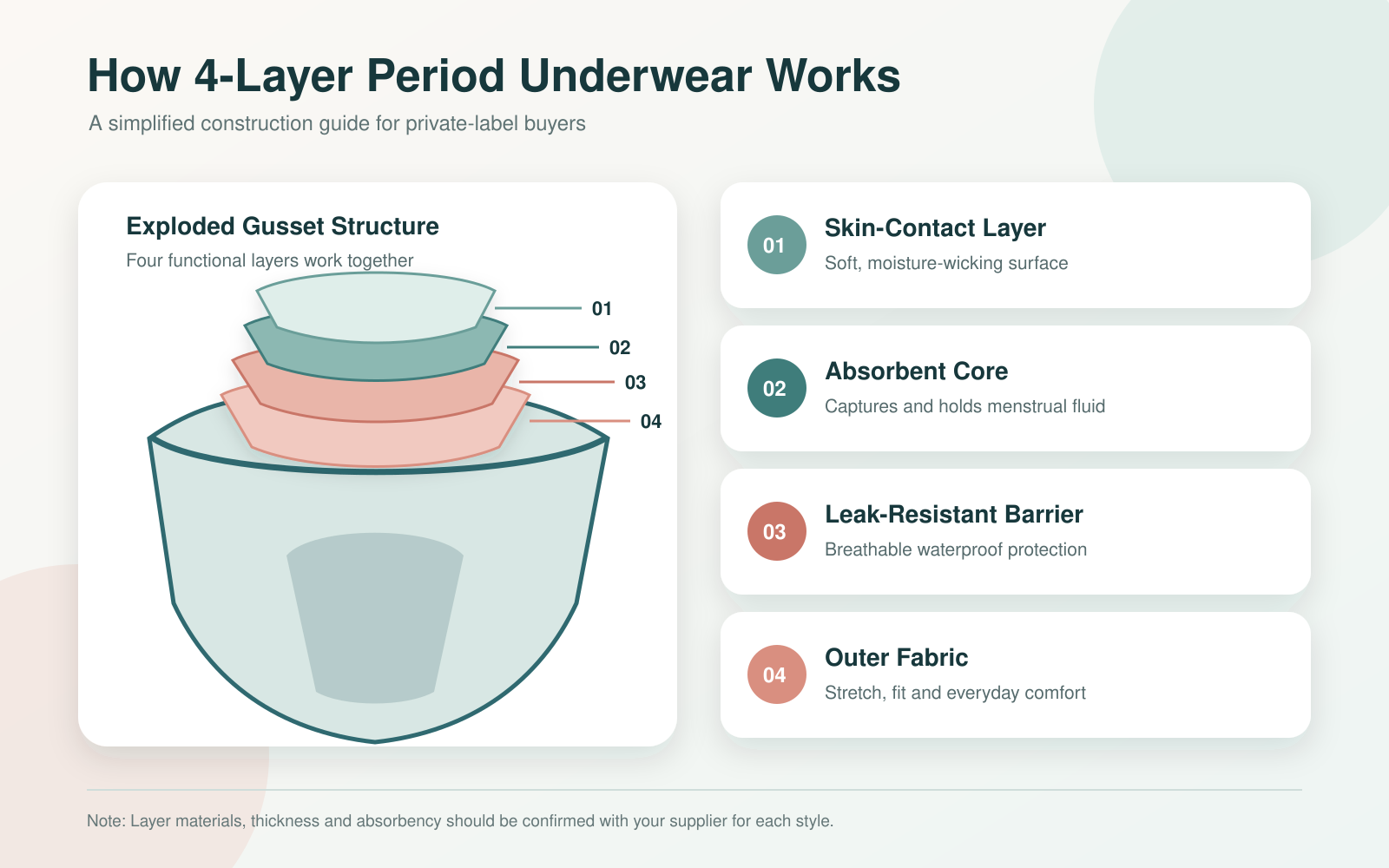
Ask the manufacturer to explain:
- The number and function of the protective layers
- The fabric composition of each layer
- Available absorbency levels
- Gusset length and coverage
- Side-leak protection options
- Breathability and drying performance
- How the structure changes between light-flow and heavy-flow styles
A reliable supplier should be able to explain these specifications clearly instead of relying only on descriptions such as “super absorbent” or “100% leakproof.”
3. Compare MOQ and Reorder Flexibility
MOQ should be evaluated at several levels. Ask whether the quoted MOQ applies to the complete order, each style, each color, each size, custom fabric, logo application or custom packaging.
An offer of “500 pieces MOQ” may still require 500 pieces per color or style. That can make the real opening order much larger than expected.
For a new brand, a low-MOQ private label order can reduce inventory risk. It allows you to test several styles and identify the strongest products before committing to deeper customization. Linglu Apparel supports selected low-MOQ period underwear orders starting from 10 pieces, making it possible for smaller brands and wholesalers to test demand before scaling.
4. Evaluate the Sample Development Process
Never approve period underwear based only on photographs. A physical sample should be used to evaluate fabric hand feel, waistband recovery, leg-opening comfort, stitching quality, gusset position, absorbency, leakage under pressure, drying time, size accuracy and appearance after washing.
Ask whether the supplier provides stock samples, customized samples or both. Stock samples are useful for checking existing quality quickly. Customized samples are necessary when you change the fabric, absorbency structure, sizing, color, logo or packaging.
Before paying for a sample, confirm the sample cost, production time, shipping cost and number of revisions included.
5. Request Measurable Absorbency Specifications
Terms such as light, medium and heavy flow can mean different things to different suppliers. Ask for measurable information whenever possible:
- Approximate absorption capacity in milliliters
- Test method used by the supplier
- Whether the product has been tested under pressure
- Front and back gusset coverage
- Recommended usage scenario
- Performance after repeated washing
Absorption capacity should not be evaluated alone. A product may absorb a large amount of liquid but still feel bulky, dry slowly or leak at the sides. The best construction depends on your target customer and brand positioning.
6. Review Materials, Testing and Target-Market Requirements
Period underwear is worn close to the skin, so material documentation is an important part of supplier evaluation. Ask for available fabric specifications, test reports and certificate numbers. Verify that documents are current and apply to the actual material or finished product being quoted.
For example, OEKO-TEX STANDARD 100 covers textiles tested for harmful substances. However, buyers should still verify the certificate scope instead of assuming that every product made by a supplier is automatically covered.
Depending on your target market, you may also need to discuss restricted substances, PFAS-related declarations or testing, colorfastness, wash durability, fabric composition labeling, care labels, packaging information and audit requirements. Do not accept a certification logo alone. Request the certificate number, validity period and product scope.
7. Clarify the Customization Scope
The terms OEM, ODM and private label are sometimes used differently by suppliers. Define the actual work in writing.
Private label customization may include adding your logo to an existing style, custom labels, available colors, existing fabrics and branded retail packaging. Deeper product development may include new patterns, custom size grading, different gusset structures, custom absorbency levels, exclusive prints, new fabric sourcing and custom trims.
Ask which elements can be customized at your opening MOQ and which require a higher production quantity.
8. Inspect Quality-Control Procedures
A good sample does not guarantee a good bulk order. Ask how the supplier controls quality during production and before shipment.
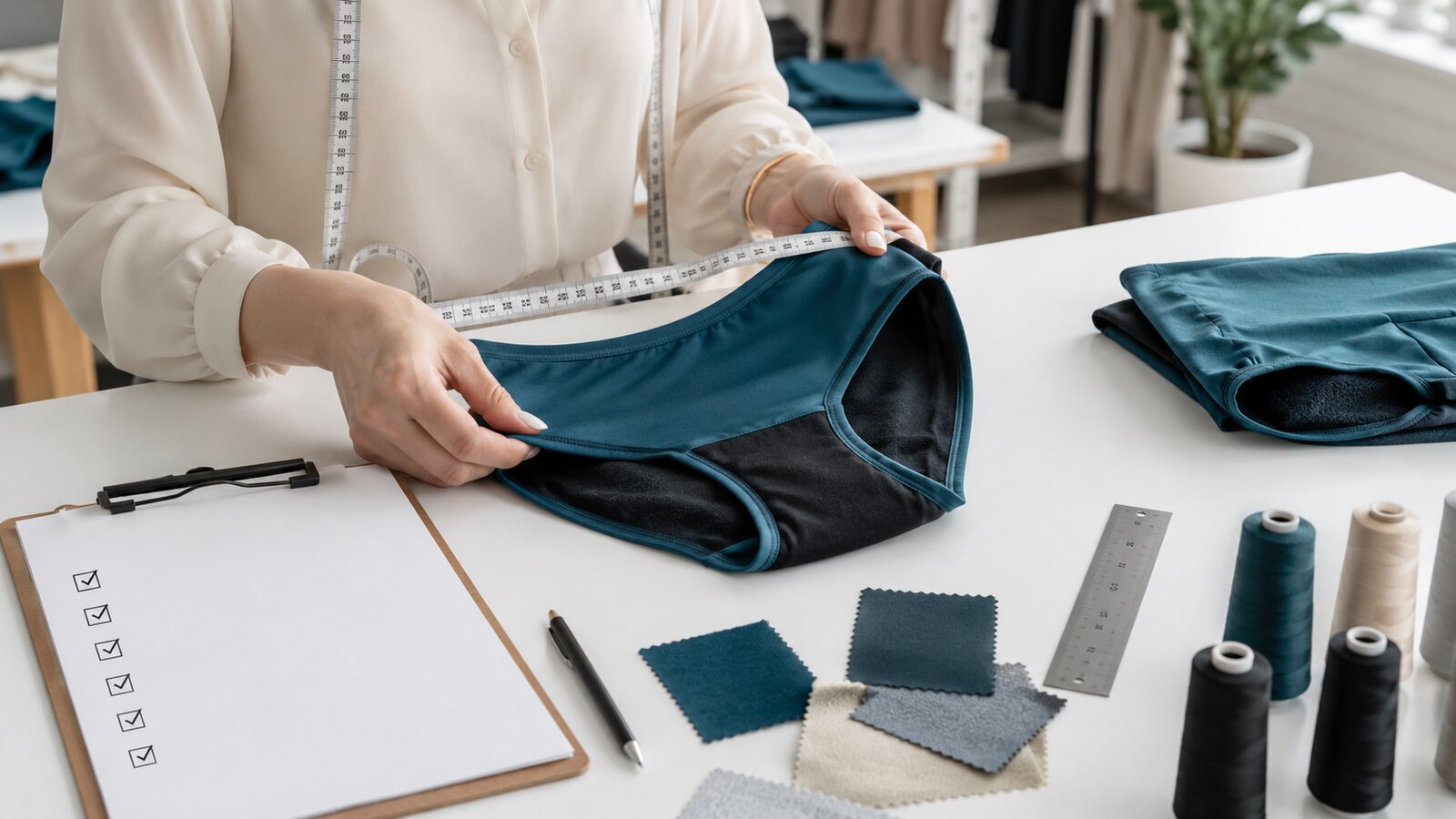
- Incoming fabric inspection
- Fabric color and shrinkage checks
- Cutting accuracy
- Stitching and seam inspection
- Gusset position
- Measurement tolerance
- Absorbency or leakage testing
- Logo and label placement
- Packaging verification
- Final random inspection
For the first bulk order, consider agreeing on a written inspection standard or arranging a third-party inspection. The goal is to define what counts as a defect before production begins.
9. Compare Total Cost, Not Only Unit Price
The lowest product price is not always the lowest final cost. Your complete sourcing cost may include samples, development, patterns, labels, packaging, testing, inspection, shipping, import duties, defective-product allowance and inventory costs.
A slightly higher unit price may be more economical if the supplier offers a lower test-order MOQ, more stable quality and fewer development revisions. Ask for a quotation that separates product, customization, packaging and shipping costs.
10. Test Communication Before Placing a Large Order
Communication quality during sampling often predicts what will happen during production. A reliable supplier should confirm your requirements in writing, identify missing specifications, recommend suitable products, explain cost differences, provide realistic timelines and keep sample and bulk specifications consistent.
Be cautious if a supplier agrees to every request without checking technical feasibility. Professional suppliers may ask more questions because they are trying to prevent production mistakes.
Period Underwear Manufacturer Evaluation Scorecard
| Evaluation area | Suggested weight |
|---|---|
| Product construction and absorbency knowledge | 25% |
| Sample quality and development process | 20% |
| Testing and quality control | 20% |
| MOQ and reorder flexibility | 15% |
| Communication and response quality | 10% |
| Total sourcing cost | 10% |
Score each potential supplier using the same requirements. This makes comparison more objective than choosing based on price or product photos alone.
Warning Signs to Watch For
- They cannot explain the protective layer structure
- They use only vague absorbency claims
- They refuse to provide samples
- They cannot confirm MOQ by style, color and size
- They show expired or unrelated certificates
- They change specifications during quotation
- They offer an unrealistic production timeline
- They avoid discussing inspection standards
- They push a large order before you approve samples
Questions to Ask a Period Underwear Manufacturer
- What period underwear styles do you currently produce?
- What absorbency levels and gusset structures are available?
- What is the MOQ per style, color and size?
- Can I start with existing styles and add my logo?
- What fabrics and size ranges can I choose?
- How much do samples cost, and how long do they take?
- What testing reports or material documents are available?
- How do you inspect absorbency, stitching and measurements?
- What customization is available at my opening quantity?
- What information do you need to prepare an accurate quotation?
How Linglu Apparel Supports New and Growing Brands
Linglu Apparel offers a selection of reusable period underwear in thong, brief, high-waist and boxer styles, with light, medium and high absorbency options.
For selected products, buyers can start with a low MOQ from 10 pieces and add custom logo options. This allows brands, wholesalers and e-commerce sellers to test products before expanding into larger orders or deeper customization.
Instead of receiving a complete catalogue, buyers can provide their target market, customer group, preferred style and absorbency level. We can then recommend two or three suitable products for initial evaluation.
Explore our period underwear collection or contact Linglu Apparel to request matched product recommendations and a sample quotation.
Frequently Asked Questions
What is a good MOQ for private label period underwear?
The right MOQ depends on the level of customization. Existing styles with a custom logo may support a lower quantity, while custom fabrics, colors, patterns or packaging usually require higher MOQs.
Should I order samples before placing a bulk order?
Yes. Samples allow you to evaluate fit, fabric, gusset coverage, absorbency, stitching and wash performance before approving bulk production.
How should period underwear absorbency be compared?
Ask for measurable absorption capacity, gusset coverage, layer structure and testing information. Do not compare products using only labels such as “heavy flow.”
Can period underwear styles be customized?
Common options include logos, labels, colors, packaging, fabrics, waist heights, size ranges and absorbency structures. Availability depends on the order quantity.
What should I send to receive an accurate quotation?
Provide your target market, customer group, preferred style, absorbency level, size range, branding requirements, quantity and desired delivery date.
Related Period Underwear Buyer Guides
- Private Label Period Underwear MOQ – Plan a lower-risk sample or first order.
- Period Underwear Materials – Compare body fabrics, absorbent cores and leak-resistant barriers.
- Period Underwear Manufacturing Process – Understand the steps from tech pack to bulk production.
Compare the checklist with a real sourcing option. Visit Linglu’s private label period underwear manufacturer page for company facts, MOQ guidance, sampling, customization, quality checks and inquiry steps.
Ready to Compare Period Underwear Manufacturers?
Share your target market, preferred style, quantity and customization needs. Linglu Apparel will recommend 2–3 suitable period underwear styles for your first test.