
“Light,” “moderate,” “heavy,” and “overnight” appear simple on a product page. For a buyer, however, these labels can hide very different test conditions, gusset dimensions, fabrics, and performance expectations. Two products may both claim “heavy absorbency” while using different liquids, application speeds, leakage endpoints, or pressure conditions.
This guide explains period underwear absorbency levels from a product-development and sourcing perspective. It will help private label brands turn a marketing label into a measurable specification, compare samples more fairly, and build a focused product range without ordering too many overlapping SKUs.
Quick answer: there is no universal number of milliliters for “light,” “moderate,” or “heavy” period underwear. Capacity depends on the complete gusset, test liquid, loading speed, pressure and leakage endpoint. Buyers should ask for a documented test method and compare samples under the same conditions.
What Do Period Underwear Absorbency Levels Mean?
Absorbency level is a shorthand description of how much liquid a period underwear style is intended to manage and how the wearer is expected to use it. It usually combines several ideas:
- total liquid capacity before visible leakage;
- how quickly the gusset takes in liquid;
- how well the core distributes and retains moisture;
- how dry the top surface feels after loading;
- where and for how long the product is intended to be worn.
The four most familiar consumer-facing levels are light, moderate, heavy, and overnight. Some brands add “super,” “ultra,” or “maximum.” These names are useful for navigation, but they are not a universal technical standard. A buyer should treat the label as the start of the specification—not the specification itself.
Why Absorbency Labels Cannot Be Compared at Face Value
Brands often translate absorbency into milliliters, tampon equivalents, or hours of wear. These formats make a product easier to understand, but the underlying test method may differ. For example, the liquid can be added slowly or rapidly, in one location or across the gusset, with or without pressure. The end point may be the first visible drop, a specified amount of strike-through, or the maximum mass gain of an absorbent component.
Published brand guides demonstrate this variation. Knix describes levels using tampon equivalents, while Modibodi publishes milliliter figures for its own absorbencies. These are brand-specific communication systems, not a common industry conversion table. Your supplier should therefore reproduce your claim using an agreed method rather than simply matching a label used by another brand.
A Practical Absorbency Matrix for Product Planning
The following ranges can be used as a first planning brief. They are intentionally broad and overlapping because construction and test conditions change the result. Do not print an absorbency claim on packaging until it has been verified on the final garment with an agreed protocol.
| Level | Illustrative planning range | Typical product role | Common style direction | Key buyer question |
|---|---|---|---|---|
| Light | About 5–10 ml | Light days, spotting, discharge, or backup use | Thong, bikini, or low-profile brief | Can the gusset stay thin and flexible while controlling rewet? |
| Moderate | About 10–20 ml | Everyday core style for a broad customer group | Bikini, brief, or high waist | Does the product balance capacity, comfort, and drying time? |
| Heavy | About 20–35 ml | Higher-flow use or longer wear within the brand’s instructions | Brief, high waist, or full-coverage bikini | Does the absorbent zone remain stable under movement and pressure? |
| Overnight | About 30 ml and above | Extended coverage for sleep or maximum-protection positioning | Full brief, boyshort, or extended-gusset style | Is protection extended far enough at the front and back for the intended sleep position? |
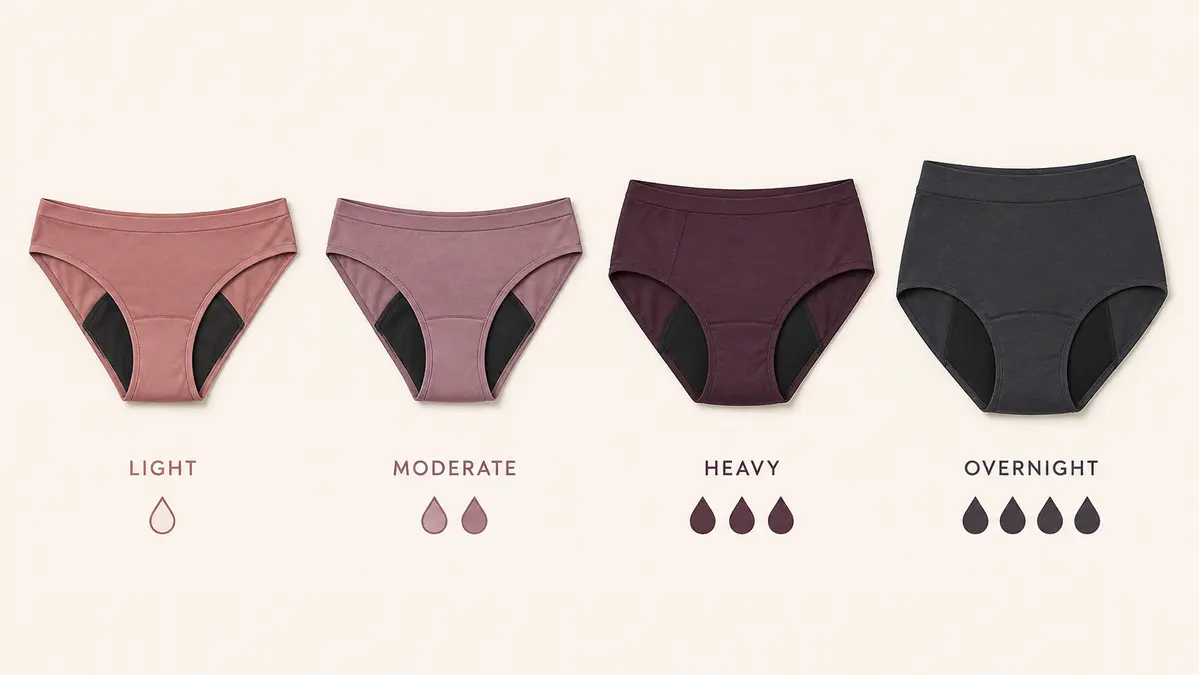
A useful range is not defined by capacity alone. Light products usually compete on discretion and fast drying. Moderate products often carry the largest sales volume because they cover everyday use. Heavy and overnight styles need more attention to retention under pressure, rear coverage, seam placement, and laundering performance.
The Layer System Behind Period Underwear Absorbency
Most period underwear uses a multi-layer gusset, although the number and composition of layers vary. Each layer should perform a specific job.
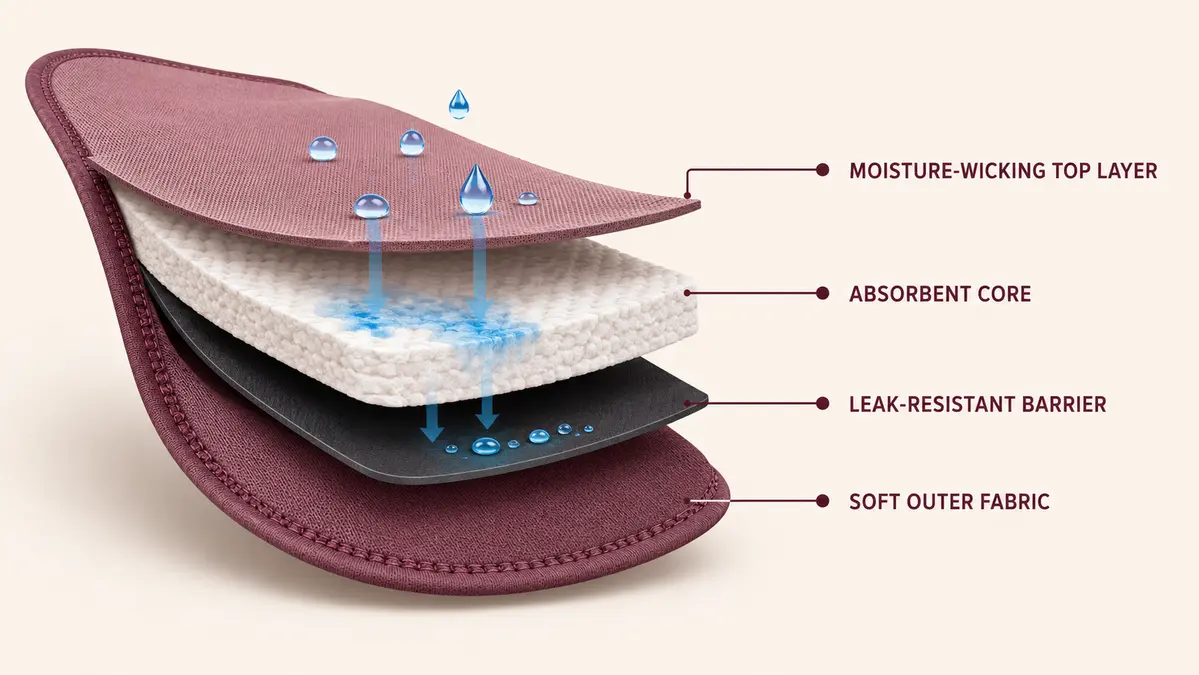
1. Moisture-wicking top layer
The skin-contact layer should accept liquid quickly and move it toward the absorbent core. Softness matters, but a soft fabric that holds liquid at the surface can create a wet feeling. Fiber type, knit structure, finish, and laundering all influence intake and rewet.
2. Absorbent and distribution core
The core stores liquid and spreads it away from the point of entry. A thicker core may increase capacity, but thickness alone does not guarantee faster acquisition, better distribution, or lower rewet. Buyers should evaluate performance and hand feel together.
3. Leak-resistant barrier
This layer helps prevent liquid from reaching the outer fabric. It must be integrated without excessive noise, stiffness, heat, or delamination. Seam and needle-hole management are especially important because a strong central barrier does not protect a weak edge.
4. Outer shell and garment structure
The body fabric, elastics, gusset shape, and seam construction keep the absorbent system close to the body. Poor fit can create channels or gaps even when the gusset has adequate laboratory capacity. More layers are therefore not automatically better; the goal is a coordinated garment system.
Five Performance Metrics Buyers Should Test
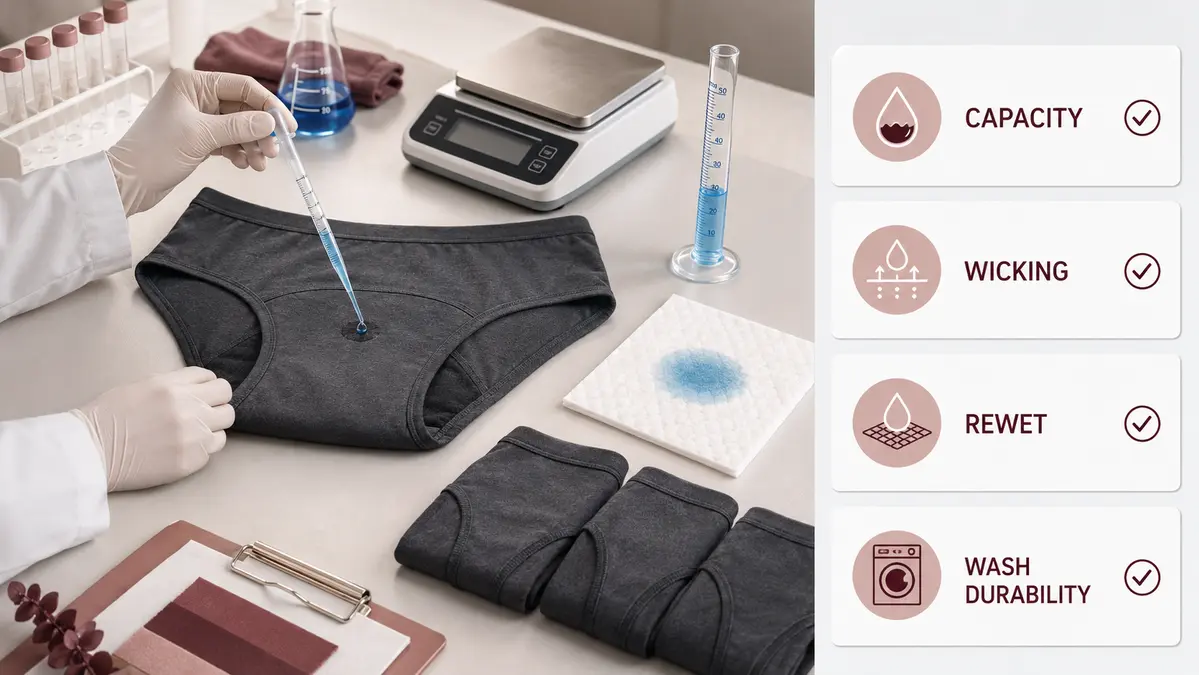
1. Capacity before leakage
This is the most marketable number, but the test must state the liquid, application rate, loading area, garment position, pressure condition, and leakage end point. A capacity figure without a method is difficult to reproduce.
2. Acquisition and wicking speed
A product can have high theoretical capacity yet leak during a rapid local load if intake is slow. Wicking also determines whether liquid spreads into unused parts of the core instead of pooling at one point.
3. Retention under pressure
Sitting, sleeping, walking, and tight clothing apply pressure to the loaded gusset. A buyer should check whether absorbed liquid is released when the sample is compressed, not only how much it absorbs while lying flat.
4. Surface rewet
Rewet measures the liquid that returns to the skin-side surface under defined pressure. It is a useful companion to total capacity because two cores with similar capacity can feel very different during wear.
5. Performance after repeated washing
Reusable period underwear must be evaluated after laundering. Check capacity, intake, barrier integrity, delamination, shrinkage, gusset distortion, elastic recovery, colorfastness, drying time, and odor retention at the cycle count stated in the brief. Testing only a new sample leaves the largest durability question unanswered.
How to Write an Absorbency Test Brief
A repeatable brief allows the factory, brand, and third-party laboratory to evaluate the same target. Include at least the following parameters.
| Test parameter | What the buyer should define |
|---|---|
| Sample identity | Style, size, color, material version, gusset construction, and production stage |
| Conditioning | Preconditioning environment and whether samples are new or prewashed |
| Test liquid | Specified liquid, temperature, and any relevant preparation procedure |
| Application | Volume per dose, flow rate, loading point, interval, and garment position |
| Leakage end point | Exact visual or measured criterion used to stop the test |
| Pressure and rewet | Load, contact material, duration, and acceptable transfer |
| Laundering | Cycle count, detergent, temperature, drying method, and retest points |
| Sampling and tolerance | Number of specimens, allowed variation, and pass/fail rule |
For third-party verification, Hohenstein’s Tested Period Underwear program references FEMTECHMAS-6513-1:2023 and includes maximum absorption capacity before leakage. AATCC also publishes textile methods covering absorbency, moisture management, wicking, drying, laundering-related dimensional change, and hydrostatic pressure. These methods can support material and component evaluation, but a fabric test alone should not be presented as proof of whole-garment leak protection.
Match Absorbency to Style and Gusset Geometry
Capacity targets must fit the silhouette. A light thong has limited area and should prioritize a slim, stable gusset. An everyday bikini can support a moderate core while remaining discreet. Heavy briefs need enough width and edge control to use the core effectively. Overnight products often benefit from a longer protective zone toward the back—and sometimes the front—rather than simply adding thickness in the center.
- Gusset length: Does the absorbent zone cover the intended loading and movement area?
- Gusset width: Is coverage maintained without causing bulk or folding?
- Edge construction: Can liquid migrate toward seams or needle holes?
- Body fit: Does the gusset stay close to the body across the size range?
- Drying surface: Does the selected geometry make washing and air drying practical?
Evaluate at least one smaller, one middle, and one larger size. Scaling only the waistband while leaving the gusset unchanged can create inconsistent coverage across the size set.
Plan a Balanced Private Label Absorbency Range
A new brand rarely needs every silhouette at every absorbency. A focused launch is easier to explain, test, forecast, and reorder. One practical three-SKU structure is:
| Starter SKU | Role in the range | Development priority |
|---|---|---|
| Moderate everyday brief or bikini | Broadest everyday use and likely core-volume style | Comfort, discretion, fit, and repeatable performance |
| Heavy high-waist brief | Higher-capacity option with fuller coverage | Retention, gusset stability, and edge protection |
| Overnight full brief or boyshort | Maximum-coverage solution and clear range upgrade | Extended front/rear geometry and sleep-position testing |
Start with limited body colors and a controlled size range, then expand after real sales data identifies demand. Every additional fabric, color, logo, package, or absorbency construction can affect production minimums. Our guide to private label period underwear MOQ explains how to structure a lower-risk first order.
Sample Evaluation Checklist Before Bulk Production
- Confirm that the sample code matches the approved bill of materials and gusset construction.
- Record dry weight, gusset dimensions, and thickness before testing.
- Test new and laundered samples using the same documented protocol.
- Observe intake, spreading, side leakage, back leakage, rewet, and pressure release.
- Check comfort when dry, partially loaded, and near the stated capacity.
- Inspect seam puckering, barrier damage, delamination, odor, and drying time after washing.
- Repeat the evaluation across representative sizes and more than one specimen.
- Keep one sealed approval sample and a signed specification for production comparison.
Absorbency performance should sit inside a broader supplier assessment covering materials, quality control, customization, communication, and testing support. Use our detailed checklist on how to choose a period underwear manufacturer before committing to bulk production.
Information to Send Your Manufacturer
The fastest development starts with a clear brief. Send your target customer, consumer-facing absorbency name, verified capacity target, preferred silhouette, front and rear gusset coverage, body and gusset materials, size range, color plan, logo method, packaging, testing requirements, target price, and expected quantity.
If you do not yet have a fixed milliliter target, share the intended use and benchmark sample, then ask the manufacturer to propose a construction and test plan. Request results for both new and washed garments and state which claims you intend to use online or on packaging.
Questions to Ask Before Approving an Absorbency Claim
- Which exact test method produced the stated capacity?
- Was the result measured on the complete garment or only an absorbent material swatch?
- How many samples and sizes were tested?
- What liquid, application rate, loading point, and leakage end point were used?
- Was retention or rewet measured under pressure?
- How did performance change after the specified wash cycles?
- Does the production tolerance protect the lowest-performing acceptable unit?
- Which laboratory or quality-control record can support the final marketing claim?
Build Your Period Underwear Absorbency Range with Linglu
The best absorbency range is easy for customers to understand and precise enough for a factory to reproduce. Linglu supports private label buyers with style selection, gusset construction, material options, sampling, customization, and production planning across period underwear styles.
Contact Linglu with your target absorbency levels, styles, size range, and order quantity. We can help you turn the concept into a sample and a clear development brief.
Frequently Asked Questions
What are the main period underwear absorbency levels?
The most common consumer-facing levels are light, moderate, heavy, and overnight. Some brands also use super or ultra. Because these labels are not standardized, buyers should define each level with a tested capacity, use case, construction, and test method.
How many milliliters should heavy-absorbency period underwear hold?
A 20–35 ml range can be a useful development starting point, but there is no universal number for “heavy.” The claim must be tied to the final garment and a documented protocol, including liquid type, flow rate, pressure, and leakage end point.
Is a tampon-equivalent absorbency claim standardized?
No single tampon-equivalent conversion is used by every period underwear brand. If this format is used, document the tampon capacity assumed in the calculation and retain test evidence for the underwear claim.
Does a thicker gusset mean better absorbency?
Not necessarily. Thickness may add storage capacity, but acquisition speed, distribution, retention, rewet, barrier integrity, fit, and seam construction also affect performance. A bulky core can create comfort and drying-time tradeoffs.
How should buyers test period underwear after washing?
Define the detergent, wash temperature, cycle type, drying method, and cycle count in advance. Retest absorbency, intake, rewet, barrier integrity, fit, shrinkage, delamination, and drying time at the agreed checkpoints.
Which absorbency levels should a new brand launch first?
Many new brands can begin with a moderate everyday style, a heavy full-coverage style, and an overnight option. The best mix depends on the target customer, price position, climate, channel, and order budget. A focused range usually produces clearer demand data than many overlapping SKUs.
How much can period underwear hold?
The answer varies by construction and test method, so a single industry-wide capacity cannot be assumed. Ask the supplier for capacity-before-leakage results together with the liquid type, application rate, pressure conditions and wash-cycle status used in testing.
Related Period Underwear Buyer Guides
- Period Underwear Materials – Learn how each fabric and functional layer affects comfort, absorption and leak resistance.
- Period Underwear Manufacturing Process – Follow absorbency requirements from product development through testing and bulk production.
- Bulk & Wholesale Period Underwear – Compare product styles and request matched samples for your target flow levels.
Need help matching absorbency to your market? Explore Linglu’s private label manufacturing capabilities for gusset development, samples, custom branding and bulk production planning.
Not Sure Which Absorbency Level Fits Your Market?
Tell us your customer group, use scenario and target flow level. We will recommend suitable gusset coverage and absorbency options for sample comparison.