
Choosing period underwear materials is not simply a choice between cotton, modal, or nylon. A finished garment combines several material zones, and each zone must perform a different job: the body fabric controls fit and hand feel, the top layer manages liquid intake, the core stores moisture, and the barrier helps prevent leakage.
For private label buyers, the real question is not “Which fabric is best?” It is “Which material system fits our absorbency target, silhouette, price point, care instructions, and market claims?” This guide turns common fabric names into a practical sourcing specification.
Quick answer for buyers: polyamide is the European and technical name commonly used for nylon. It can be a strong body-fabric option when you need a smooth hand feel, abrasion resistance and fast drying, but long-term retention depends on the complete knit, elastane percentage, heat setting, gusset construction and wash performance—not the fiber name alone.
Why Period Underwear Materials Matter
Materials influence nearly every part of the customer experience: softness, stretch, breathability, bulk, drying time, odor retention, wash durability, and perceived value. They also affect production minimums, color availability, lamination compatibility, lead time, testing requirements, and cost.
A premium body fabric cannot compensate for a slow-wicking top layer. A high-capacity core can still perform poorly if the gusset bunches or releases moisture under pressure. A strong barrier can fail at seams or delaminate after repeated washing. Material decisions must therefore be evaluated as one garment system.
The Five Material Zones Buyers Should Specify
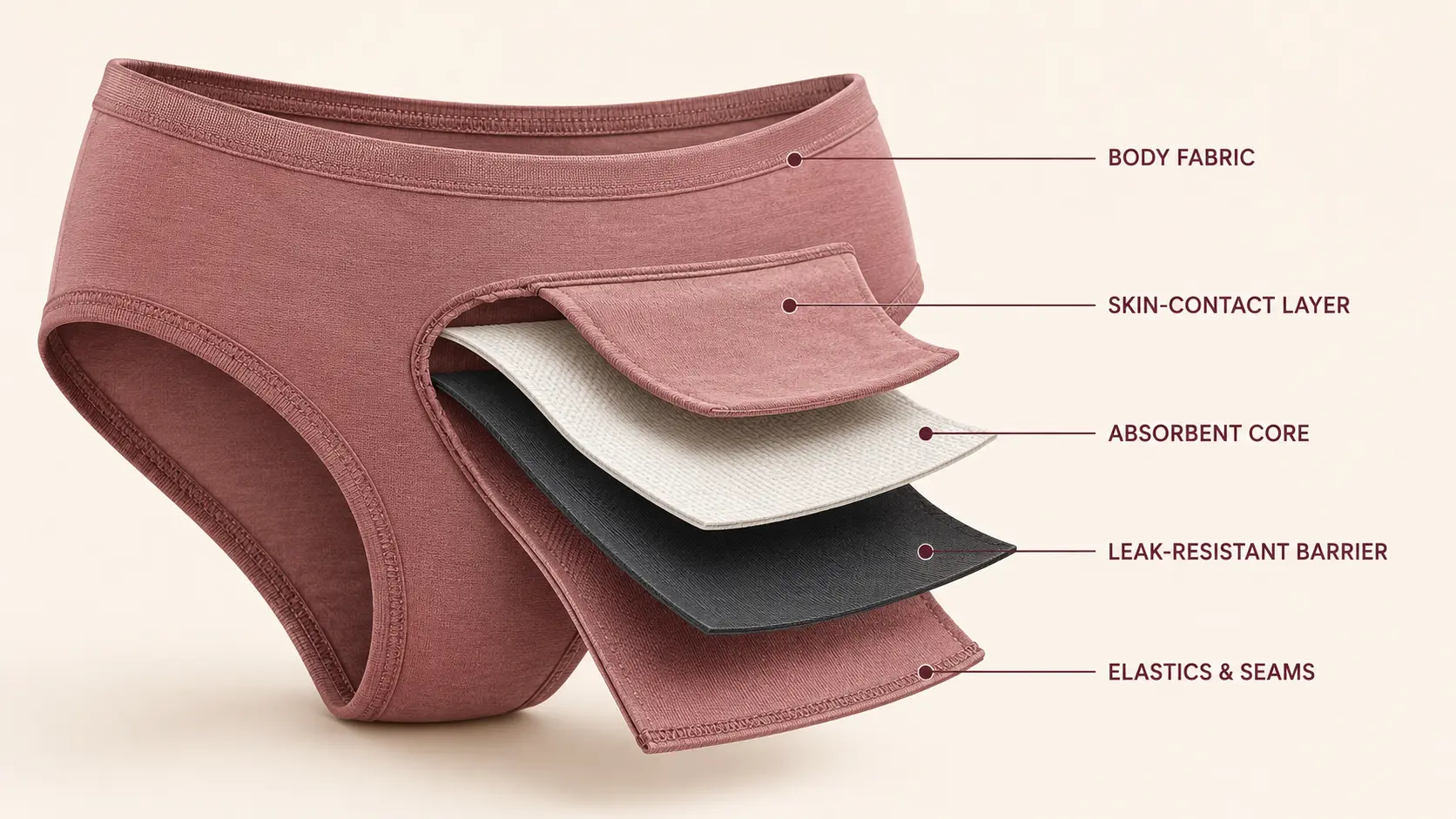
1. Body fabric
The main shell determines the look, hand feel, stretch, recovery, opacity, and fit of the underwear. Cotton-elastane, modal blends, polyamide-elastane, and polyester-based microfibers are common directions. Fiber content alone is not enough: knit structure, yarn size, fabric weight, finish, and elastane performance all change the result.
2. Skin-contact top layer
The top layer should accept liquid quickly and transfer it toward the core while maintaining a comfortable surface. Depending on the design, buyers may evaluate cotton blends, brushed or perforated synthetic knits, and cellulosic blends. Softness and wicking should be tested together because a soft hand does not automatically mean fast intake or low rewet.
3. Distribution and absorbent core
The core spreads and stores moisture. Textile constructions can include microfiber, terry, fleece, nonwoven, or cellulosic blend components selected for the target capacity and thickness. Core performance depends on fiber, density, surface structure, layer area, compression, and laundering—not only the number of layers.
4. Leak-resistant barrier
A thin membrane or laminated textile is commonly used to reduce liquid penetration to the outer shell. TPU-laminated fabrics are one common direction; “PUL” is also widely used as a sourcing term. Buyers should specify the base fabric, membrane type, lamination method, thickness, stretch direction, hydrostatic resistance, bond durability, breathability expectations, and wash conditions.
5. Elastics, thread, trims, and seams
Functional materials do not stop at the gusset. Waist and leg elastics control fit and edge sealing, while thread and seam construction influence durability and leakage paths. Labels, heat transfers, lace, bonding films, and adhesives must also be compatible with washing and any chemical requirements applied to the finished product.
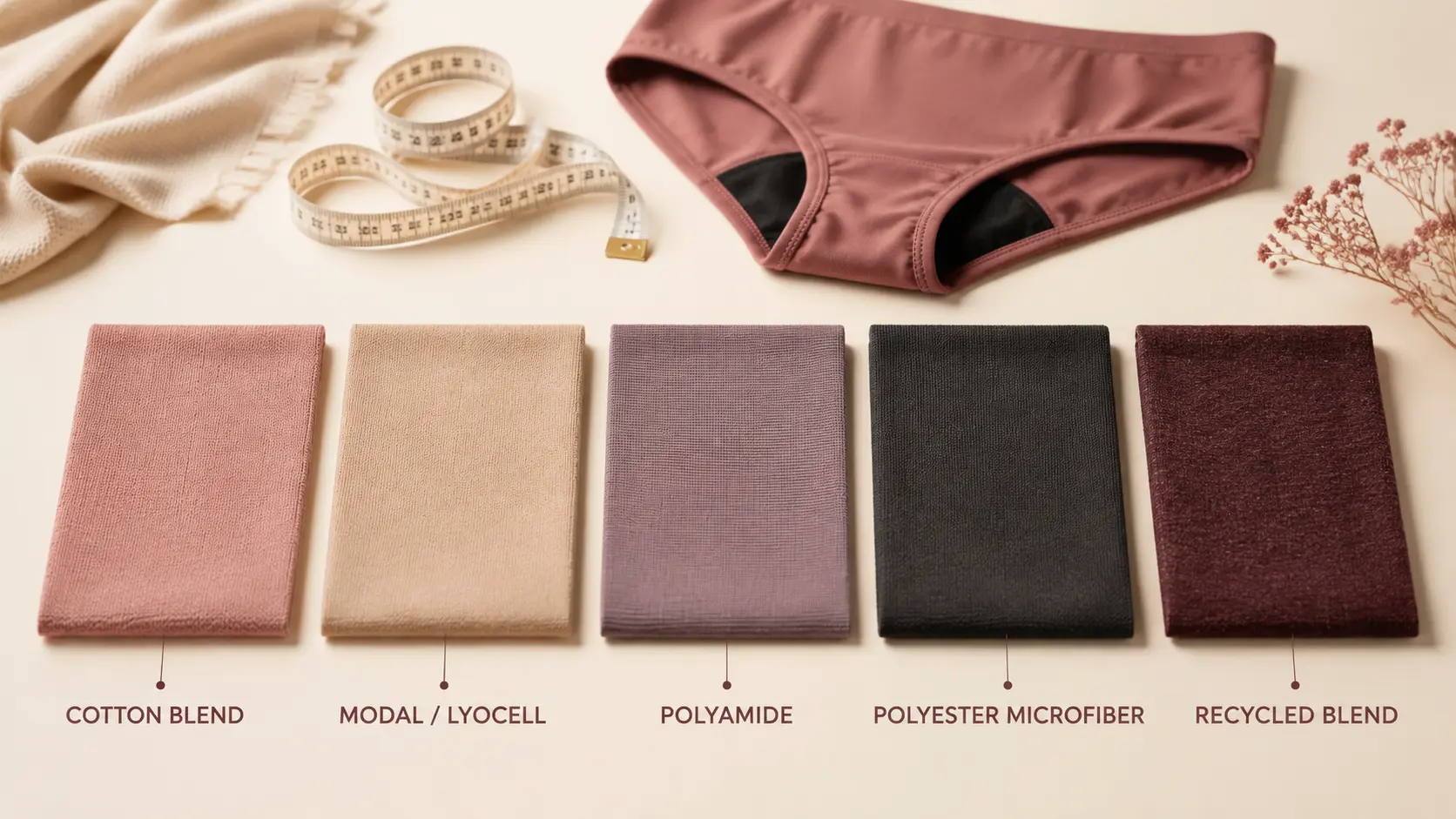
Compare Common Body Fabric Options
The following table is a development guide rather than a universal ranking. Final performance depends on the exact fabric specification and finished garment.
| Fabric direction | Potential advantages | Points to evaluate | Common positioning |
|---|---|---|---|
| Cotton-elastane knit | Familiar hand feel, matte appearance, easy everyday positioning | Drying time, shrinkage, surface pilling, colorfastness, recovery after washing | Everyday briefs, teen ranges, cotton-led brands |
| Organic cotton blend | Supports an organic-fiber story when certification and chain of custody are valid | Certificate scope, minimum order, shade consistency, cost, claim and labeling rules | Premium or sustainability-led collections |
| Modal or lyocell blend | Soft, smooth hand and fluid drape | Wet dimensional stability, pilling, recovery, source documentation, care method | Comfort-focused premium styles |
| Polyamide-elastane | Smooth surface, strong stretch potential, fast-drying direction | Heat sensitivity, shine, snagging, dye consistency, elastane recovery | Seamless, active, laser-cut, or sleek styles |
| Polyester microfiber blend | Durable, lightweight, quick-drying potential and broad finish options | Surface feel, odor retention, pilling, wicking finish durability | Performance-led or value-focused ranges |
| Recycled synthetic blend | Can support recycled-content positioning with traceable documentation | Certification scope, batch consistency, color minimums, cost, physical performance | Sustainability-led active or seamless ranges |
Ask for a fabric specification sheet and a physical swatch before selecting by fiber name. Two fabrics labeled “95% cotton, 5% elastane” can differ significantly in weight, stretch, recovery, opacity, shrinkage, and hand feel.
Compare Gusset Layer Material Options
| Gusset function | Possible material direction | Buyer performance checks |
|---|---|---|
| Skin-contact intake | Wicking polyester or polyamide knit, cotton blend, modal or lyocell blend | Acquisition speed, surface rewet, softness, staining, performance after washing |
| Distribution | Structured knit, brushed microfiber, engineered cellulosic or synthetic blend | Horizontal spread, local pooling, thickness, compression behavior |
| Absorbent storage | Microfiber, terry, fleece, cellulosic blend, textile or nonwoven composite | Total capacity, retention under pressure, bulk, drying time, wash durability |
| Leak-resistant barrier | TPU-laminated knit or another specified membrane composite | Hydrostatic resistance, pinholes, bond strength, flexibility, heat and wash resistance |
| Gusset cover or outer face | Body fabric or a compatible lightweight knit | Appearance, seam stability, colorfastness, stretch compatibility |
The same core should not automatically be used across light, moderate, heavy, and overnight products. Capacity, gusset length, layer area, compression, drying time, and silhouette must be developed together. Our guide to period underwear absorbency levels explains how to turn consumer-facing labels into measurable targets.
Natural vs. Synthetic Is the Wrong Starting Question
Buyers sometimes assume that natural fibers are always more comfortable or that synthetic fibers are automatically less desirable. Period underwear is a functional garment, and both groups can play useful roles. A cotton-rich shell may support a familiar everyday feel, while a synthetic wicking knit or laminated barrier may provide more predictable moisture transfer or faster drying.
A better decision framework is:
- What is the intended absorbency and wear scenario?
- Which hand feel and visual position does the brand need?
- How quickly must the product dry after washing?
- Which stretch, recovery, and opacity targets must be maintained across sizes?
- Which claims require certification, traceability, or laboratory evidence?
- Can the supplier reproduce the same material performance in bulk?
Match Materials to the Product Position
Everyday moderate brief
Prioritize a comfortable body fabric, balanced stretch and recovery, a discreet gusset, moderate drying time, and repeatable performance. This is often the core-volume SKU, so material availability and reorder consistency matter as much as novelty.
Heavy or overnight style
Prioritize distribution, retention under pressure, barrier integrity, extended gusset geometry, and stability after washing. Adding core thickness without evaluating fit and drying time can create a bulky product that still leaks at the edges.
Active or seamless style
Prioritize recovery, edge stability, low-profile construction, heat or bonding compatibility, and moisture management during movement. Laser-cut and bonded designs require material trials because not every stretch fabric bonds or seals consistently.
Premium cotton or sustainability-led range
Prioritize traceable input materials, valid certificate scope, claim accuracy, color consistency, shrinkage control, and a construction that still meets functional targets. A sustainability story should not replace absorbency, leakage, and durability testing.
Material Specifications to Put in the Tech Pack
“Soft cotton” or “breathable microfiber” is not a production specification. Use measurable fields that can be approved, tested, and reproduced.
| Specification field | What to define |
|---|---|
| Fiber composition | Generic fiber names, percentages, and permitted tolerance |
| Fabric construction | Knit type, yarn information where relevant, finish, and surface direction |
| Fabric weight | Target GSM and acceptable tolerance |
| Stretch and recovery | Lengthwise and crosswise stretch, recovery method, and test condition |
| Dimensional stability | Allowed shrinkage or growth after the agreed wash cycles |
| Color performance | Shade standard, colorfastness requirements, staining and migration checks |
| Moisture performance | Intake, wicking, drying, rewet, and absorbency targets as applicable |
| Barrier performance | Membrane construction, hydrostatic target, pinhole criteria, and bond durability |
| Chemical requirements | Restricted substances list, destination-market requirements, and required reports |
| Wash protocol | Detergent, temperature, cycle count, drying method, and retest points |
Keep an approved swatch and sealed garment sample with the signed specification. For bulk production, material inspection should compare composition documents, weight, width, shade, stretch, shrinkage, surface defects, and lamination quality against the approved standard.
Certifications, PFAS Testing, and Claim Documentation
Certification names are often used loosely in sourcing conversations. Buyers should verify the certificate number, holder, product scope, validity, and whether it covers the actual material or finished product being ordered.
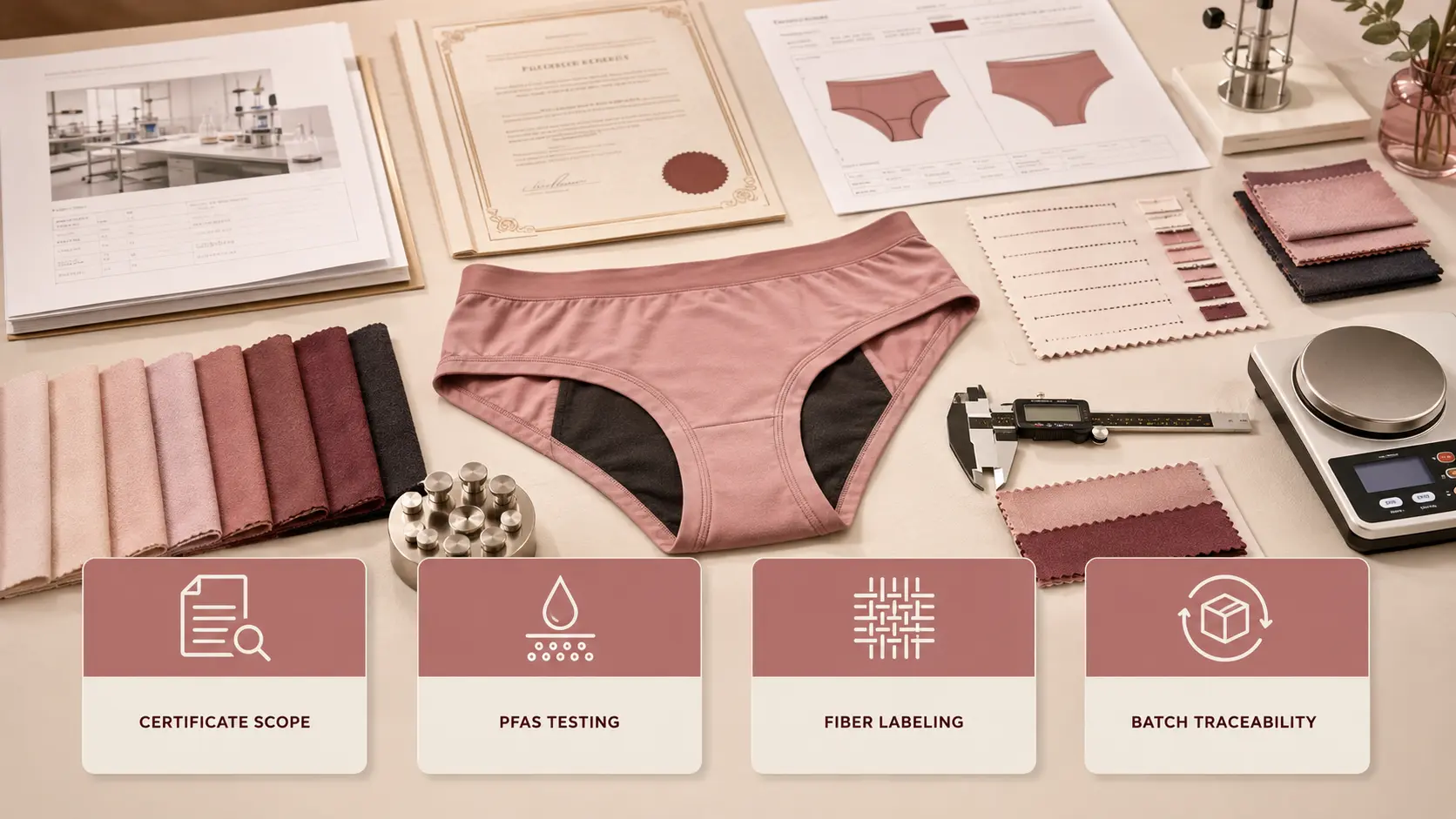
- OEKO-TEX® STANDARD 100 is a label for textiles tested for harmful substances. Confirm which components and product scope are covered rather than assuming one fabric certificate covers the entire garment.
- GOTS covers certified organic fiber content together with processing, chemical, environmental, social, traceability, and labeling requirements. GOTS states that certified products must contain at least 70% certified organic fibers, with label grades depending on the percentage.
- PFAS-related claims should be supported by a defined testing and supplier-control program appropriate to the destination market. Agree on the sample, test scope, laboratory, reporting limit, color coverage, and retest schedule before using an absolute claim.
- Recycled-content claims should be supported by traceable documentation and any certification required by the brand or market. Confirm that the specific supplier, material, and transaction are inside the certificate scope.
A generic laboratory report from a fabric mill is not automatically evidence for every production lot, color, finish, adhesive, or complete garment. Build a document matrix that connects each claim to the bill of materials and final SKU.
A Labeling Trap: “Bamboo” Fabric
Soft fabrics marketed casually as “bamboo” are often rayon or viscose produced from bamboo as a cellulose source. For products sold in the United States, the Federal Trade Commission’s bamboo textile guidance states that textiles can only be called bamboo when they are made directly from actual bamboo fiber; rayon or viscose made from bamboo should be identified accordingly.
Do not copy a supplier’s informal fabric name directly onto a care label, product page, or package. Ask for the legally recognized generic fiber composition and review destination-market labeling requirements before approving artwork.
Sample Tests to Complete Before Bulk Production
- Fit and recovery: Check waistband, leg opening, gusset stability, and recovery across representative sizes.
- Wash durability: Retest shrinkage, pilling, elastics, lamination, seams, and functional performance after the specified cycles.
- Liquid management: Evaluate acquisition, spreading, capacity, rewet, leakage, and retention under pressure using an agreed method.
- Color performance: Check shade consistency, crocking, staining, migration, and appearance after washing.
- Material safety and claims: Complete the reports required for the destination market and verify that samples match the final bill of materials.
Testing should be connected to a written pass/fail rule, not a general statement that the sample “looks good.” If you are still qualifying suppliers, use our guide on how to choose a period underwear manufacturer to review production experience, quality control, testing support, and communication.
How Materials Affect MOQ, Cost, and Lead Time
Stock fabrics and existing gusset constructions usually create a faster, lower-risk development route. Custom colors, exclusive fabric weights, new laminations, certified materials, special finishes, and custom elastic can each introduce separate minimums or longer lead times.
- A body fabric may have a minimum per color.
- A laminated barrier may require a separate production quantity.
- Custom-dyed elastic and lace can carry their own minimums.
- Certified or recycled materials may have limited supplier and color options.
- Laboratory testing adds sample quantity, cost, and calendar time.
Ask the manufacturer to separate garment MOQ, fabric MOQ, color MOQ, and trim MOQ. Our private label period underwear MOQ guide shows how to calculate the real size of a first order and avoid hidden minimums.
Questions to Ask a Period Underwear Material Supplier
- What is the complete fiber composition, GSM, knit construction, and finish?
- Which material is used in each gusset layer, and why was it selected?
- Are the body fabric, gusset, elastics, thread, and trims covered by the requested documentation?
- Which performance reports are available for new and washed samples?
- What are the material, color, lamination, and trim minimums?
- How much batch-to-batch variation is allowed for weight, shade, stretch, and functional performance?
- Can the exact construction be maintained for repeat orders?
- Which claims can be supported with current, SKU-specific evidence?
Information to Send Your Manufacturer
Send the target customer, silhouette, absorbency level, preferred hand feel, body composition direction, gusset layer requirements, size range, colors, care instructions, certifications, restricted substances list, intended product claims, testing plan, quantity, target cost, and launch date.
If the construction is not fixed, share a benchmark sample and rank your priorities. For example: “soft cotton-rich body, moderate absorbency, low-profile gusset, air dry within one day under our test conditions, three neutral colors, and documentation suitable for our destination market.” A ranked brief helps the supplier explain tradeoffs instead of guessing.
Develop Your Period Underwear Material System with Linglu
There is no single fabric formula for every brand. The right construction connects the intended wearer, absorbency, fit, price, care method, and claim strategy. Linglu supports private label buyers with material selection, gusset development, sampling, customization, and production planning across period underwear styles.
Contact Linglu with your target style, absorbency, material direction, size range, and order quantity. We can help turn the concept into a practical sample brief.
Frequently Asked Questions
What materials are period underwear made from?
Period underwear usually combines a stretch body fabric, a skin-contact intake layer, an absorbent and distribution core, and a leak-resistant membrane or laminated textile. Elastics, thread, adhesives, trims, and seams are also part of the functional material system.
Is cotton the best fabric for period underwear?
Cotton can provide a familiar, comfortable body-fabric direction, but no single fiber is best for every layer or product. Buyers should compare hand feel, wicking, drying, recovery, shrinkage, absorbency, barrier performance, and wash durability on the final garment.
What is the leakproof layer made from?
A TPU-laminated textile is one common leak-resistant construction, and PUL is a common sourcing term. The buyer should specify the membrane and base fabric, lamination method, stretch, hydrostatic performance, flexibility, bond strength, and wash requirements.
Is bamboo period underwear made from bamboo fiber?
Many soft textiles marketed as bamboo are rayon or viscose made from bamboo as a cellulose source. Use the legally recognized generic fiber name required in the destination market and do not rely on an informal supplier description.
How can a buyer verify a PFAS-related claim?
Use a written restricted substances requirement, supplier declarations, traceable material records, and a testing plan agreed with a qualified laboratory for the destination market. Define the tested SKU, colors, method, reporting limit, and retest schedule before approving claim language.
Which materials should a new private label brand choose first?
A new brand can reduce development risk by starting with a proven stock body fabric and existing gusset construction that meet its target hand feel and absorbency. Custom materials can be introduced after sales data justifies additional minimums, testing, and lead time.
Is polyamide a good fabric for period underwear?
Polyamide, also called nylon, can provide a smooth surface, strength and quick drying for the body fabric. Buyers should still test pilling, recovery, colorfastness, breathability and wash durability on the finished garment because performance depends on fabric construction and finishing.
Which period underwear fabric has the best long-term retention?
No fiber guarantees the best retention by itself. Long-term performance comes from a stable body knit, suitable elastane, controlled shrinkage, durable absorbent layers, secure lamination and seams, and verified results after repeated wash cycles. Compare finished-garment test data rather than relying only on cotton, modal or polyamide labels.
Related Period Underwear Buyer Guides
- Period Underwear Manufacturing Process – See how material decisions move through sampling, testing, bulk production and inspection.
- Bulk & Wholesale Period Underwear – Explore styles and absorbency options for wholesale and custom orders.
Turning a material specification into a finished product? See Linglu’s private label period underwear manufacturing service for sampling, material confirmation, customization, quality checks and production planning.
Compare Materials Before Approving Samples
Share your target hand feel, breathability, absorbency and price position. We will help you compare suitable body fabrics and protective-layer options before sample development.